
The fastest occupancy cost reduction wins come from three places: lease outgoings audits, energy efficiency upgrades (without specific figures), and space optimisation in roughly that order of speed to cash. Lease and outgoings fixes pay back within a lease cycle. Energy retrofits and NABERS upgrades take longer but lift asset value. Space optimisation sits between the two, and getting it wrong (cutting area without checking work-point demand) often costs more than it saves.
TL;DR:
- Conducting an outgoings reconciliation audit can recover costs within 4 to 8 weeks without requiring capex or business case development.
- Improving NABERS energy ratings through retrofit measures like HVAC optimization and sub-metering can significantly boost asset value and marketability.
- Regularly checking GST treatment and lease definitions during reconciliation prevents avoidable overcharges and minimizes cost leaks.
- Space right-sizing depends on actual work-point data; upgrading buildings quality may be more cost-effective than downsizing in some cases.
- An independent tenant-focused advisor like Nicheadvisory ensures cost reductions align with your interests, not the landlord’s, across all roadmap stages.
Table of Contents
- Top occupancy cost reduction strategies to prioritise
- How does energy efficiency lower occupancy costs?
- What outgoings and GST issues drive up occupancy costs?
- Can you cut space without cutting productivity?
- Building an occupancy cost reduction roadmap
- Where Nicheadvisory fits in your cost reduction program
- Sources
- FAQ
Top occupancy cost reduction strategies to prioritise
Every occupancy cost reduction program should start with a short list of levers, each with a clear owner and a realistic timeframe. Here’s how they stack up.
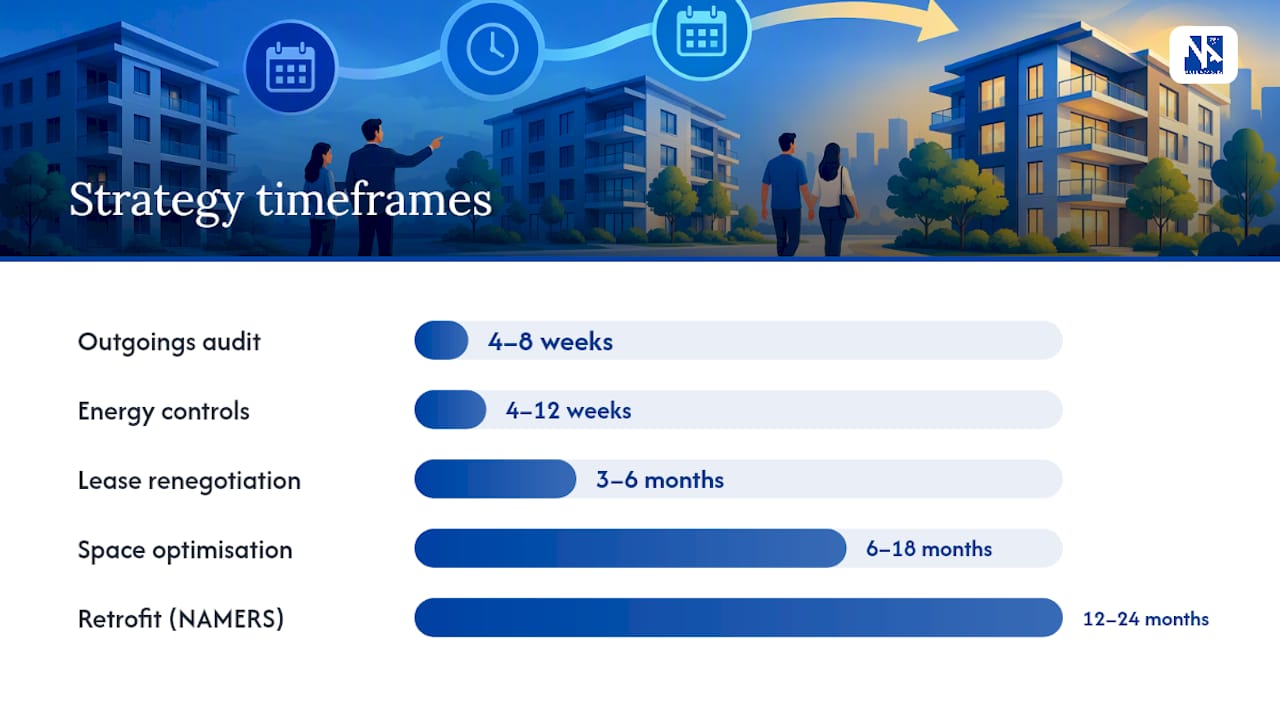
- Outgoings reconciliation audit — Owner: finance/lease administrator. Timeframe: 4 to 8 weeks. Catches billing errors and overcharged categories; often the single fastest cash recovery available.
- Lease renegotiation at renewal or review — Owner: tenant advisor/finance. Timeframe: 3 to 6 months before expiry. Resets rent, caps outgoings growth, and can shift makegood liability.
- Operational energy controls (BMS tuning, HVAC scheduling, lighting sensors) — Owner: facilities. Timeframe: 4 to 12 weeks. Low capital, immediate consumption drop.
- NAMERS-driven capital retrofit — Owner: facilities/asset team. Timeframe: 12 to 24 months. Higher capital outlay, larger structural savings and asset-value uplift.
- Space optimisation and right-sizing — Owner: workplace strategy lead. Timeframe: 6 to 18 months. Reduces rent and outgoings proportionally to area cut, but needs occupancy data first.
- Sublease or surplus space disposal — Owner: tenant advisor. Timeframe: variable, market-dependent. Converts dead cost into recovered income or reduced liability.
The quickest wins with the least capital are the outgoings audit, BMS scheduling changes, and renegotiating ambiguous outgoings caps at the next lease event. None of them require a fitout or a business case to start.
Pro Tip: Run the outgoings audit before you touch the lease. Landlords are far more willing to fix billing errors quietly than to admit them mid-negotiation.
How does energy efficiency lower occupancy costs?
Energy is one of the most controllable line items in occupancy cost, and tenancy energy use can represent a significant portion of an office building’s total energy consumption, according to NABERS guidance. That’s the portion tenants can directly influence through their own fitout, equipment and operating hours, independent of what the landlord controls in base building plant.
A NABERS tenancy rating gives you a baseline and a target. It also matters commercially: buildings and tenancies with strong ratings are easier to market and hold value better, which counts if you’re negotiating a sublease or planning an exit.
Existing commercial buildings account for a noteworthy portion of Australia’s greenhouse gas emissions, and a national review found several policy and incentive options that make energy upgrades cost-effective at scale, per DCCEEW’s analysis.
Typical retrofit measures, roughly in order of cost:
- LED lighting upgrades with occupancy sensors
- Sub-metering to isolate tenancy versus base building consumption
- HVAC re-zoning and controls optimisation
- Building management system (BMS) recommissioning
In ageing buildings, HVAC is usually the single biggest energy consumer, so a targeted HVAC optimisation paired with a modern BMS often delivers the largest saving from one project. One Australian case study found a 2.5-star NABERS improvement produced measurable annual energy savings, lower emissions, and a material lift in asset value, documented in Energy. Financing routes worth checking before you self-fund a retrofit include environmental upgrade agreements, government grants, and energy performance contracts, all of which can shorten payback considerably, per the same DCCEEW report.
Pro Tip: When building the business case, add asset-value uplift and improved leaseability to the NPV, not just energy savings. Leaving those out understates the return and can kill a good project on paper.
What outgoings and GST issues drive up occupancy costs?
Outgoings are usually the least scrutinised line in a lease, and that’s exactly why they leak money. Most net leases pass through rates, insurance, cleaning, and management fees, reconciled annually against a budget estimate charged monthly. If nobody checks the reconciliation against the lease definition of “outgoings,” overcharges compound year on year.
GST adds another layer. All outgoings paid by a tenant form part of the consideration for the supply of the premises, and adjustment events at reconciliation can change the GST payable, according to ATO guidance. Getting the GST treatment wrong on a reconciliation adjustment is a common and avoidable cost.
A short outgoings audit checklist:
- Confirm the lease definition of recoverable outgoings against what’s actually being charged.
- Compare the current year’s budget to the prior year’s actual reconciliation.
- Check GST treatment on any adjustment events.
- Flag categories that have grown faster than CPI or the lease’s cap.
- Request supporting invoices for the three largest outgoings categories.
Negotiation levers worth pushing at renewal include capping annual outgoings growth, tightening the definition of recoverable items, and resolving makegood obligations early rather than at expiry, when leverage is weakest. Accurate lease administration and regular reconciliation are low-cost governance moves that tend to deliver immediate cash recovery just by eliminating billing errors.
Pro Tip: Negotiate the makegood clause at lease signing, not at exit. It’s the single most expensive line item tenants leave until they have zero bargaining power.
Can you cut space without cutting productivity?
Right-sizing works when it’s based on actual work-point data, not a percentage guess. National occupational density sits at 12.5 square metres per person as of 2025, according to the Department of Finance’s occupancy reporting, which also tracks work-point vacancy and cost-per-work-point. Those benchmarks are a useful reference point before committing to a downsizing target.
Levers that reduce effective area without cutting capacity:
- Activity-based working zones instead of fixed 1:1 desking
- Hot-desking or hoteling for roles with high mobility or hybrid patterns
- Storage rationalisation (digitising records, reducing filing footprint)
- Consolidating meeting rooms into flexible, bookable zones
Downsizing isn’t always the answer. Major occupiers are increasingly chasing higher-quality buildings, and the Property Council’s Office Market Report describes the current market as a story of quality and location rather than raw square metre age. A smaller floor in a better-performing building can cost less per effective work-point than a larger floor in an older one, once energy, amenity and productivity are factored in. Sublease exposure and unused capacity are the other silent cost: track vacant work-points monthly, not annually, so surplus space gets flagged before it becomes dead rent.
Building an occupancy cost reduction roadmap
A realistic program runs in three stages over 12 to 24 months.
- Diagnostic (weeks 1 to 6): Install or audit sub-metering, establish a cost baseline by category, assign clear ownership between facilities, finance and the landlord relationship.
- Short-term (0 to 6 months): Run the outgoings reconciliation, fix BMS scheduling and lighting controls, resolve any GST reconciliation errors.
- Medium-term (6 to 24 months): Build the business case for a NABERS-linked retrofit, execute space optimisation once work-point data is solid, and negotiate lease terms at the next review.
Track KPIs monthly for the first year: cost per square metre, cost per work-point, NABERS score, and vacancy rate. Set KPIs that combine financial and utilisation metrics rather than tracking cost alone, since a falling cost-per-square-metre figure means little if work-point vacancy is climbing at the same time, based on Department of Finance occupancy frameworks.
Where Nicheadvisory fits in your cost reduction program
Running this roadmap well needs a tenant-first advisor in the room, not a landlord’s agent wearing two hats. Nicheadvisory acts exclusively for tenants and owner-occupiers, which means the outgoings audit, the lease negotiation, and the retrofit business case all get assessed against your interests, not the building owner’s.
Experienced teams have spent over 12 years running engagements of this kind across major Australian cities, matching each stage of the roadmap to a specific service. Workplace strategy engagements set the work-point baseline and right-size targets before anyone touches a floor plan. Corporate tenant advocacy handles the lease audit, outgoings reconciliation, and renewal negotiation. When a retrofit or fitout business case gets the green light, project and construction management carries it through delivery, and for retrofit design input, a partner resource like 3D Cityplanner’s commercial building design work is worth a look during the concept stage.
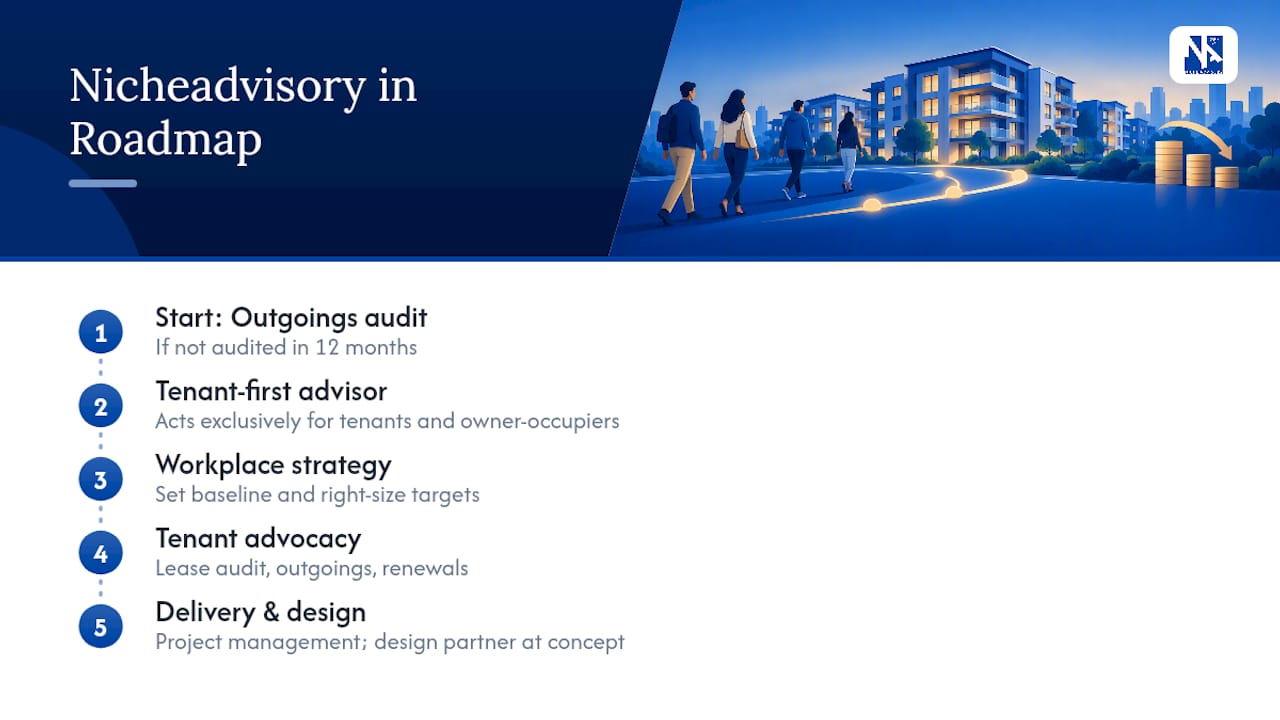
Clients receive independent advice at every decision point, with savings measured against appropriate KPIs rather than landlord-focused metrics. If your occupancy costs haven’t been audited in the past 12 months, that’s the logical place to start. Get in touch with Nicheadvisory to scope the diagnostic phase.
Sources
- Office Market Report – Property Council Australia
- NABERS Energy | NABERS
- Achieving low energy existing commercial buildings in Australia
- Australian Government Office Occupancy Reports | Department of Finance
- Energy
FAQ
What is the fastest way to reduce occupancy costs?
An outgoings reconciliation audit typically delivers the fastest result, often within 4 to 8 weeks, because it catches billing errors and overcharges without any capital spend. Pairing it with BMS and lighting control adjustments adds a second quick win on the energy side.
What is a NABERS rating and why does it matter for occupancy costs?
A NABERS tenancy rating measures a tenancy’s actual energy performance, and tenancy energy use can represent around half of a building’s total consumption according to NABERS. It gives tenants a benchmark to target energy-cost reductions and supports marketability if the space is later subleased or vacated.
How much office space do we actually need per employee?
National occupational density sits at 12.5 square metres per person as of 2025, per the Department of Finance, though the right figure for your business depends on work-point utilisation data, not headcount alone. A workplace strategy assessment measures actual usage before any downsizing target is set.
Does downsizing office space always cut costs?
Not always. Major occupiers are increasingly favouring higher-quality buildings, according to the Property Council, and a smaller floor in a well-performing building can cost less per effective work-point than a larger floor in an older, inefficient one.
How does GST affect lease outgoings reconciliation?
Outgoings paid by a tenant form part of the taxable supply of the premises, and reconciliation adjustments can trigger GST adjustment events, per ATO guidance. Getting this wrong at reconciliation is one of the more common, avoidable cost errors tenants encounter.
What does Nicheadvisory charge for a lease or occupancy cost review?
Pricing depends on the scope of the engagement, whether it’s a workplace strategy assessment, a tenant advocacy negotiation, or full project delivery. Current details are available directly through Nicheadvisory’s service pages.
Recommended
- Niche Advisory: Educating Tenants on Saving Costs in Non-Traditional Ways
- Commercial Lease Assistance During COVID-19 (Part One)
- Sydney Commercial Lease Surrender: This is How a Tenant Advisor Can Help You Through Tough Times
- Sydney Commercial Lease: Re-Negotiating Your Lease in the Time of COVID-19