
Lease critical dates are every contractually binding deadline in a lease that triggers a right, obligation, or penalty if missed, from renewal notice windows to make-good deadlines. The moment a lease is signed, the immediate job is to abstract every date-bearing clause, compute any relative deadlines, and set layered alerts with proof-of-delivery procedures for every notice you send. Miss one of these, and you can forfeit a renewal option, trigger holdover rent, or lose audit rights permanently.
TL;DR:
- Missing renewal notice windows can cause tenants to lose the right to renew or face higher holdover rent, especially if not flagged 180 days in advance.
- Critical dates like CAM audit deadlines and TI allowance expiration are often computed from lease clauses, requiring precise extraction and regular recalculation after amendments.
- Layered alerts at 180, 90, 60, and 30 days before deadlines improve notice timing and escalation ability, with accountability assigned to specific personnel.
- Proof of service methods include registered post, tracked courier, and email receipts, all should be permanently stored to support notices sent.
- Annual lease audits and tracking system updates are essential to prevent false confidence from outdated abstracts and missed downstream date shifts.
Table of Contents
- What are lease critical dates and how do they appear in lease drafting?
- What critical dates do lease administrators need to track?
- How do you compute and extract critical dates from lease text?
- Best practices for tracking, alerts, and proof of service
- Preparing months ahead: operational timing and negotiation windows
- Expert checklist: how specialist advisory reduces critical date risk
- Sources
- FAQ
What are lease critical dates and how do they appear in lease drafting?
Every lease contains two kinds of dates: absolute and relative. An absolute date is written plainly, “the lease expires on 30 June 2027.” A relative date is computed from another event, and this is where most tracking failures happen. Clause wording like “notice must be given not less than six months prior to the expiry of the Term” doesn’t give you a date. It gives you a formula, and you have to do the maths yourself, then keep doing it every time the lease is varied.
Typical drafting language that creates these computed deadlines includes:
- Renewal exercise clauses: “the Lessee may exercise the option by notice in writing given no earlier than 12 months and no later than 6 months before expiry.”
- Rent review triggers: “the rent will be reviewed on each anniversary of the Commencement Date.”
- Audit rights: “the Lessee may dispute the outgoings statement within 90 days of receipt.”
- Make-good notice: “the Lessor may require reinstatement works, notice of which must be given not less than 60 days before expiry.”
Commencement, effective, and possession dates are often confused but carry different consequences. The commencement date usually starts the rent clock. The effective date can predate occupation if it’s tied to lease execution. The possession date marks when the tenant can physically access the premises, and fitout timelines run from there, not from signing.
What critical dates do lease administrators need to track?
A useful way to prioritise is by consequence, not chronology. Some missed dates cost you money. Others cost you the premises entirely.
- Lease commencement and expiry dates — the anchor points for every other calculation in the lease.
- Renewal option notice windows — in Australia, notice windows typically run from 3 to 12 months before expiry, and renewal is rarely automatic.
- Termination or break clause deadlines — often carry a shorter, stricter window than renewal notices and can be one-shot opportunities.
- Rent review or CPI review dates — frequently tied to ABS quarterly CPI publication schedules, not calendar anniversaries.
- CAM reconciliation and audit windows — dispute rights over outgoings statements usually close 60 to 90 days after you receive them.
- TI allowance draw deadlines — unused tenant improvement allowances are commonly forfeited if not claimed by a fixed date.
- Make-good and reinstatement milestones — notice periods for reinstatement works can run parallel to, but separately from, expiry.
- Security deposit release and service contract cut-offs — smaller in dollar terms individually, but they accumulate across a portfolio.
Critical dates commonly tracked in a lease abstract include renewal notices, termination options, CAM audit windows, and TI draw deadlines, because nearly all of them are computed from other lease events rather than stated outright. The financial exposure varies wildly by category: a missed CAM audit window might cost you a few thousand dollars in overpaid outgoings, while a missed renewal notice can mean relocating an entire office.
How do you compute and extract critical dates from lease text?
The process is the same whether you’re managing one lease or two hundred: find the source date, apply the formula, record the result with its working.
- Locate the source date in the executed lease, deed of variation, or side letter, whichever governs.
- Identify the operative clause and copy its exact wording into your abstract, not a paraphrase.
- Compute the derived date using the formula in the clause.
- Record the computation with metadata: who calculated it, when, and which clause version was used.
- Flag conditional triggers separately, since some clauses activate only if another event occurs first (a rent threshold, a change of control, a subletting event).
Here’s a worked example. A lease expires 30 June 2027, and the option clause reads: “notice must be given no earlier than 12 months and no later than 6 months prior to expiry.” That gives you a notice window opening 30 June 2026 and closing 31 December 2026. Miss the close of that window by even a day, and the option can lapse.
Recomputing after every amendment matters because an outdated abstract creates false confidence, which is worse than having no abstract at all. If a variation shifts the expiry date by three months, every downstream computed date shifts with it, and nobody remembers to check unless recalculation is a mandatory step in the amendment process.
- Store the original clause text alongside the computed date, always.
- Keep scanned pages of the executed document, not just the abstract summary.
- Log the computation formula used, so a second reviewer can check your maths.
Pro Tip: Never trust a computed date you can’t trace back to its source clause. If you can’t point to the exact sentence that produced a deadline, recompute it before you rely on it.
Best practices for tracking, alerts, and proof of service
Spreadsheets fail at scale because they don’t force recalculation when a lease is varied, and nobody gets an alert when a cell goes stale. A single-source lease database, whether a dedicated system or a well-governed abstract register, solves that by tying every computed date back to its clause and flagging it for review whenever the source document changes.
Effective critical date management depends on lease abstraction, computed date fields, layered alerts, and an annual audit, because a single alert fired too close to a deadline gives you no room to negotiate or escalate. A layered cadence works better: alerts at 180, 90, 60, and 30 days before a deadline, each one triggering a different level of escalation. The 180 day alert might go to the lease administrator only. The 30 day alert should reach a decision maker with authority to act immediately.
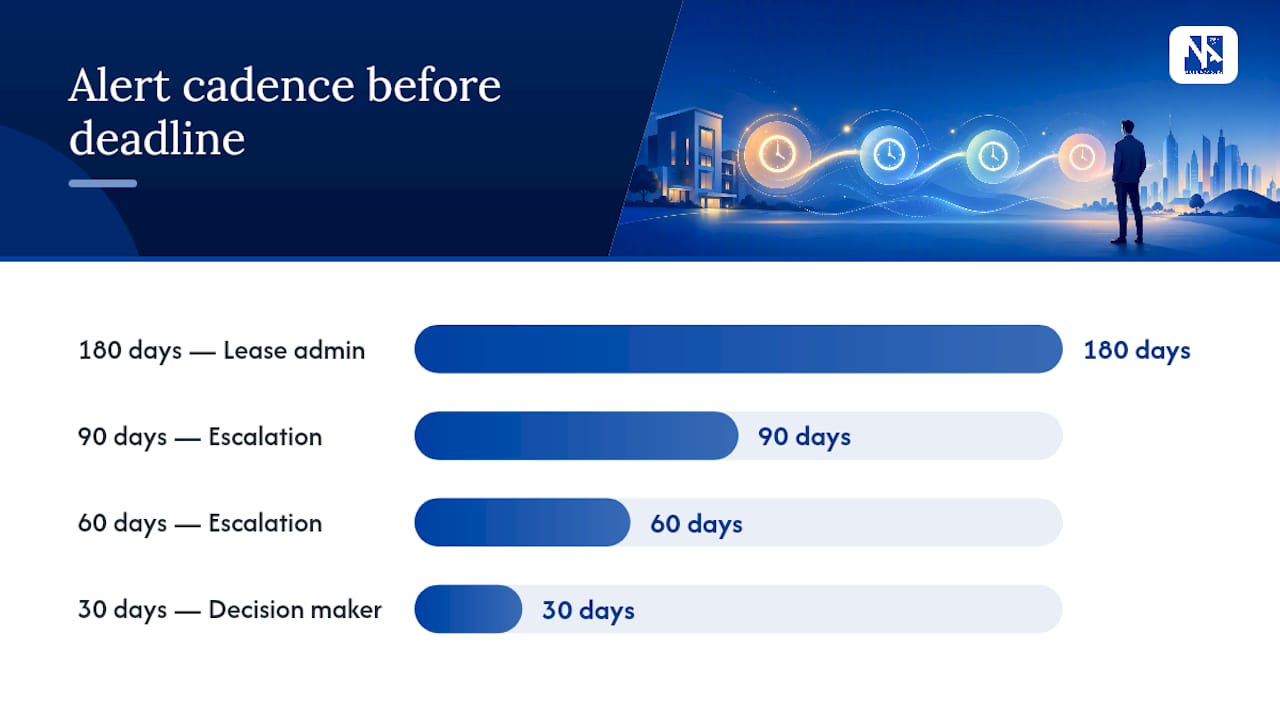
Ownership matters as much as the cadence. Someone needs to be named as the accountable party for each alert, and every action taken (or not taken) in response needs a written record. Tenants can’t rely on landlords to send a reminder; courts have upheld option forfeiture even where the landlord suffered no prejudice from the late notice.
Proof of service is where many otherwise well-run tracking systems fall down. Acceptable methods include:
- Registered post with a signed delivery receipt.
- Tracked courier with a proof-of-delivery scan.
- Email with both delivery and read receipts retained, not just sent-folder confirmation.
Keep every proof-of-service record permanently, filed against the lease it relates to. For rent reviews tied to CPI, build your alert calendar around the Australian Bureau of Statistics quarterly release schedule rather than a fixed calendar date, since automating that link reduces the risk of a procedural error voiding the review.
Preparing months ahead: operational timing and negotiation windows
Renewal negotiations that start at the deadline are negotiations you’ve already lost leverage on. Start internal approvals 9 to 12 months before expiry, and treat 6 months as the absolute minimum for serious negotiation preparation, not the trigger to start thinking about it.
- Confirm the notice window against the current, amended lease, not the original executed copy.
- Check for defaults on rent, outgoings, or compliance that could void an option.
- Reconcile current accounts, including any outstanding TI allowance draws.
- Open landlord discussions early, even informally, to test appetite for variations before formal notice is due.
If you’ve already missed a notice deadline, options narrow fast. You can attempt to negotiate a fresh agreement outside the original option (landlords sometimes agree, particularly in a soft market), but you have no contractual right to insist on it. Holdover provisions, where they exist, can carry penalty rent rates well above the passing rent. Document your intent in writing immediately, even informally, since a paper trail of good-faith attempts can matter if the situation ends up disputed.
Pro Tip: If a renewal window has already closed, don’t wait for the landlord to raise it. Write to them the same day you discover the miss, proposing terms, before holdover rent starts accruing.
Expert checklist: how specialist advisory reduces critical date risk
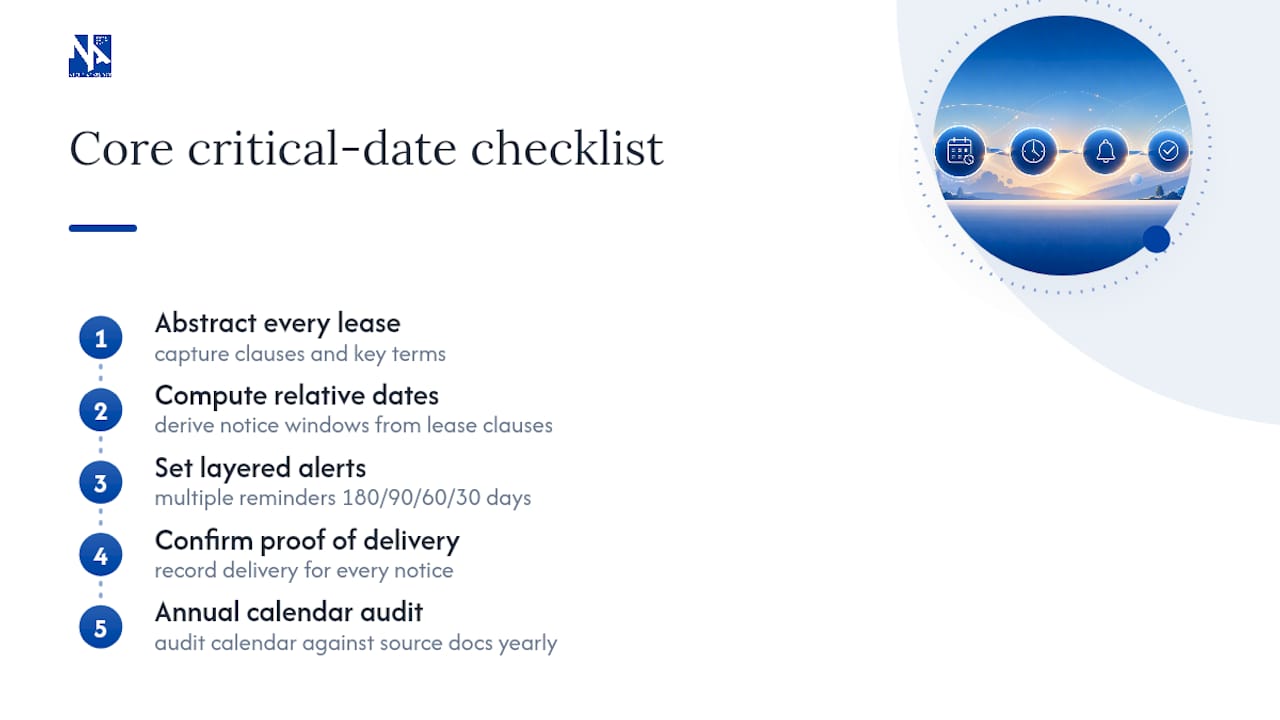
The core discipline is short enough to fit on one page: abstract every lease, compute every relative date, set layered alerts, confirm proof of delivery for every notice, and audit the whole calendar against the source documents once a year. Most missed deadlines trace back to skipping one of those five steps, usually the annual audit.
Where an adviser earns their fee is in the parts that don’t fit neatly into a spreadsheet cell: judging when to open renewal negotiations relative to market conditions, planning make-good works early enough to negotiate a fixed settlement instead of last-minute reinstatement, and spotting a conditional trigger buried in a variation that changes every downstream date. Documenting the property’s condition at lease start, well before make-good discussions begin, avoids the disputes that arise when nobody can agree what “original condition” meant.
Nicheadvisory has worked on lease administration, renewal negotiation, and make-good negotiation for tenants and owner-occupiers for over 12 years, acting exclusively for tenants rather than landlords. That independence matters when a critical date decision has real commercial weight behind it.
If your lease portfolio needs a proper critical date audit or you’re heading into a lease renegotiation without confidence in your current tracking, Corporate Tenant Advocacy support from Nicheadvisory can abstract your leases, compute the dates that matter, and manage the notice process end to end. The full range of lease administration and dispute resolution services is worth a look if you’re managing more than a handful of leases across sites. For readers also carrying cover for tenancy risk, it’s worth checking your policy against a commercial rental insurance guide to see whether financial exposure from a missed date is covered at all.
Sources
For notice mechanics and exercise requirements around renewal options, Sprintlaw’s commercial lease guidance covers the legal mechanics tenants need to follow. For the operational side of abstraction and layered alerts, Lextract’s critical dates tracking guide and the PMVA commercial property compliance calendar both set out practical frameworks. Small Business NSW also publishes retail lease guidance relevant to notice procedures.
FAQ
On what date will the lease expire?
The expiry date is stated in the lease itself, usually as an absolute date tied to the commencement date plus the agreed term length. If the lease has been varied, check the most recent deed of variation, since an amendment can shift the expiry date without anyone updating the original abstract.
What does effective date mean on a lease?
The effective date is when the lease terms become legally binding, which can be earlier than the date the tenant actually occupies the premises. It’s distinct from the commencement date, which usually starts the rent clock, and the possession date, which marks physical access.
What is the break date of a lease?
A break date is the point at which either party can exercise a break clause to end the lease early, ahead of its natural expiry. Break clauses typically carry their own notice window, often shorter and stricter than a renewal notice window, so missing a break clause deadline can forfeit that early-exit right entirely.
What are the changes to lease accounting in 2026?
Lease accounting standards themselves haven’t shifted the underlying critical date obligations tenants must track. What’s changing operationally is the growing expectation that CAM reconciliation and CPI-linked rent reviews be tied directly to published schedules like the ABS quarterly CPI release calendar rather than fixed calendar assumptions, to avoid procedural errors voiding a review.