
A correct builder tender evaluation selects the most advantageous tender, not necessarily the cheapest, using pre-published criteria, fixed weightings and a documented, auditable scoring process. That means locking in your evaluation plan before you open a single submission, screening out non-compliant bids on mandatory checks first, and only then scoring what’s left against price and non-price criteria. Skip any of those three steps and the award becomes hard to defend if challenged.
TL;DR:
- Mandatory criteria must be thoroughly checked and documented before scoring to avoid legal challenges and unfair exclusions.
- Scores for non-price criteria should be normalized before applying weightings to prevent distortion and ensure fair comparison.
- Evaluation panels must score independently and record justification for moderation decisions, especially when higher-cost bids are justified by non-price benefits.
- Tailor weightings based on project complexity and risk, with higher emphasis on capability for high-risk or specialized projects, and document the rationale upfront.
- Disclose all evaluation criteria and mandatory conditions in the tender documents to maintain transparency and compliance throughout the process.
Table of Contents
- What is a builder tender evaluation and what must it achieve?
- Mandatory criteria and the thresholds that catch evaluators out
- How do you score price against non-price criteria fairly?
- Assessing non-price criteria in practice: methodology, experience, team and systems
- How do you compare price when submissions aren’t apples for apples?
- Tailoring criteria weightings to project risk
- Compiling scores, moderation and the award recommendation
- Practitioner checklist: what actually trips up evaluators on site
- How to structure an evaluation plan and panel roles
- What common mistakes derail a builder tender evaluation?
- Legal and regulatory considerations affecting tender evaluation
- Examples of best practice tender evaluation frameworks
- Templates and policy guidance worth keeping on file
- Sources
- FAQ
What is a builder tender evaluation and what must it achieve?
A builder tender evaluation is the structured process of comparing competing construction bids against criteria set before the tender opened, so the buyer can identify the most advantageous offer rather than default to the lowest number. Procurement guidance across Australian jurisdictions requires agencies to disclose the evaluation criteria and any mandatory conditions inside the tender documents themselves, not after bids land on the desk.
Criteria generally sort into four groups, and confusing them is where most evaluation panels lose time and credibility.
- Mandatory (gating) criteria — pass/fail requirements a builder must meet to stay in the process, such as current public liability insurance, a valid building licence, or a compliant WHS management plan.
- Critical criteria — heavily weighted factors that materially affect delivery risk, like construction methodology, relevant project experience, and the proposed site team.
- Supporting criteria — secondary factors that refine the ranking without dominating it, such as quality assurance documentation or environmental management systems.
- Social and economic criteria — local content, Indigenous procurement participation, apprenticeship commitments, and SME subcontracting, which some public buyers now score as a mandatory minimum weighting on larger contracts.
Write your tender documents so each criterion demands specific, checkable evidence rather than a general statement of capability. Asking “describe your WHS approach” invites a paragraph of boilerplate; asking for a project-specific WHS plan with named hazards and control measures gives you something you can actually score.
Mandatory criteria and the thresholds that catch evaluators out
Mandatory criteria exist to filter out bids that can’t legally or practically deliver the work, before anyone spends time scoring their methodology. Get this step wrong and you either exclude a compliant builder unfairly or, worse, carry a non-compliant one through to award.
The usual mandatory checklist for construction tenders includes:
- Current public liability and works insurance at the levels specified in the tender
- Valid building licence or registration for the relevant trade class and contract value
- A project-specific WHS management plan, not a generic company policy document
- Evidence of compliance with industrial relations obligations where a Fair Jobs Code or equivalent threshold applies to the contract value or sector
- Financial capacity documentation, such as bank guarantees or evidence of working capital
Government guidance is explicit that value for money, WHS management and industrial relations compliance sit among the mandatory criteria agencies must disclose upfront. Record every pass/fail decision in writing, with the specific document or clause that triggered exclusion. A vague note like “didn’t meet requirements” won’t survive a probity challenge; “no current WHS plan submitted, clause 4.2 non-compliant” will.
How do you score price against non-price criteria fairly?
You score price against non-price criteria by normalising each to a common scale, then applying pre-set weightings, so the final ranking reflects your actual priorities rather than whichever scale happened to produce bigger numbers. This is the step where evaluations quietly go wrong, usually because someone applies weightings to raw scores instead of normalised ones.
Pro Tip: Never apply weightings directly to raw scores. A panel member scoring methodology out of 10 and another scoring it out of 100 will silently distort your result unless every score is normalised to the same scale first.
The standard method, drawn from published weighted criteria guidelines for building works, runs like this:
- Score each non-price criterion on a raw scale (commonly 0 to 10) for every tenderer.
- Sum each tenderer’s raw non-price scores.
- Normalise: the highest-scoring tenderer becomes 10, and every other tenderer is rescaled proportionally against that top score.
- Apply the non-price weighting (commonly 10% to 40% of the total, though non-price weighting on complex civil work sometimes runs as high as 40% to 70%).
- Score price: the lowest bid becomes 10, and higher bids are scaled down proportionally.
- Apply the price weighting (commonly 30% to 60%) and add both weighted totals.
Worked example: Builder A scores 8.5 raw non-price against a top score of 8.5 (normalised to 10) and bids $4.2 million. Builder B scores 7.0 raw non-price (normalised to 8.24) and bids $3.9 million, the lowest price, which normalises to 10. With a 40/60 non-price to price split, Builder A scores (10 × 0.4) + (9.29 × 0.6) = 9.57, where Builder A’s price normalises to $3.9m/$4.2m × 10 = 9.29. Builder B scores (8.24 × 0.4) + (10 × 0.6) = 9.30. Builder A wins narrowly, despite the higher price, because its non-price strength carries more weight than the $300,000 price gap.
Assessing non-price criteria in practice: methodology, experience, team and systems
Ask for evidence that lets you separate a strong response from a generic one, not just a description of intent. A methodology section should include a construction programme with sequencing, named quality hold points, and a temporary works strategy specific to your site, not a boilerplate paragraph copied from the builder’s last five tenders.
Pro Tip: If a methodology response could be submitted unchanged for a different project on a different site, it’s not scorable evidence. Send it back for clarification or score it low and note why.
What each element should demonstrate:
- Methodology — programme with critical path, sequencing logic, quality hold points, and how temporary works and site logistics are handled given your specific access and neighbour constraints.
- Experience and past performance — projects of comparable scale, type and complexity, with outcomes (on time, on budget, defect rates) rather than just a project list, backed by referee checks that ask pointed questions rather than accept a generic reference letter.
- Team CVs — named personnel for key roles, their availability across the contract period, and evidence they’ve held equivalent roles on comparable work, not just a résumé of qualifications.
- Management systems — current WHS, quality assurance and environmental management certifications, with evidence of how they’re applied on site rather than a certificate number alone.
Methodology responses frequently deliver the bulk of non-price marks on civil and building tenders, so a weak programme chart or absent hold-point schedule can cost more points than a modest price difference.
How do you compare price when submissions aren’t apples for apples?
Level every submission against the same scope before comparing dollar figures, because two builders can price the identical drawings very differently once provisional sums, exclusions and assumptions are factored in.
- List every provisional sum, allowance and exclusion each bid states, and check they cover the same scope of work.
- Flag price red flags: unusually low rates on high-risk trades, missing allowances for known site conditions, or contingency sums well below the project’s risk profile.
- Adjust bids to a common scope basis (levelling) and record every adjustment with its rationale, so a reviewer can trace how the compared figure was reached.
- Where a bid is ambiguous rather than non-compliant, issue the same clarification request to every affected tenderer, never to just one, to keep the process fair.
- Disqualify only where a bid fails a mandatory criterion, not because its price looks inconvenient relative to others.
Document levelling adjustments in the evaluation report itself, because an unexplained adjustment to one bid’s price is exactly the kind of detail a probity auditor will ask about later.
Tailoring criteria weightings to project risk
Weightings aren’t one-size-fits-all, and treating a straightforward warehouse fit-out the same way as a live hospital refurbishment usually produces a poor outcome for one of them. Match the evaluation methodology to the package’s risk profile: well-defined, low-risk works can lean price-led, while complex or occupied projects need capability to dominate the score.
- Standard new-build or fit-out: price weighting can sit toward the higher end (50% to 60%), since scope and risk are well understood.
- Occupied refurbishment: weight methodology and staging heavily, since the wrong sequencing disrupts a live business.
- Heritage or high-security sites: weight specialist experience and named personnel heavily, since generic contractors often underprice the specific compliance burden.
Whatever split you choose, write down the reasoning behind it in the evaluation plan before tenders close. A weighting decision made after you’ve seen the bids is the single fastest way to attract a probity complaint.
Compiling scores, moderation and the award recommendation
Each panel member should score independently before any group discussion, to avoid one voice anchoring everyone else’s numbers. Independent scoring followed by moderated consensus is standard best practice, and any large gap between two evaluators’ scores on the same criterion should be reconciled in the moderation meeting, with the reason recorded.
A complete evaluation report needs to show:
- Individual and moderated scores for every tenderer against every criterion
- Written justification for any moderation change or outlier resolution
- Levelling adjustments applied to price, with rationale
- Where a higher-priced tender wins, a documented explanation of the non-price benefits and whole-of-life advantages that justify the extra cost
That last point matters more than most panels realise. Selecting anything other than the lowest bid without a written rationale is the fastest way to lose an appeal.
Practitioner checklist: what actually trips up evaluators on site
Having managed builder procurement across occupied commercial fit-outs and base building works, Nicheadvisory’s project and construction management teams see the same handful of mistakes recur, regardless of project size.
- Changing a criterion or its weighting after tenders close, even informally in a panel discussion
- Accepting a generic methodology statement without asking for project-specific sequencing and hold points
- Failing to level provisional sums, so two bids that look close are actually pricing different scopes
- Letting one dominant panel member score before others have submitted independent marks
Pro Tip: Map your evaluation checklist to actual contract risk before scoring starts: site-specific WHS approach, named personnel with confirmed availability, and delivery milestones tied to your real programme. A generic checklist misses the risks that matter on your project.
Poor levelling and after-the-fact criteria changes are the two issues most likely to surface in a dispute, which is part of why independent oversight through the evaluation process, not just at award, pays for itself.
How to structure an evaluation plan and panel roles
An evaluation plan is the document that locks in criteria, weightings and process before tenders open, and it should be approved and filed before you issue the invitation to tender, not drafted retrospectively to justify a result. At minimum it needs to set out the mandatory criteria, the weighted criteria and their percentages, the scoring scale, the panel composition, and the timeline for evaluation and moderation.
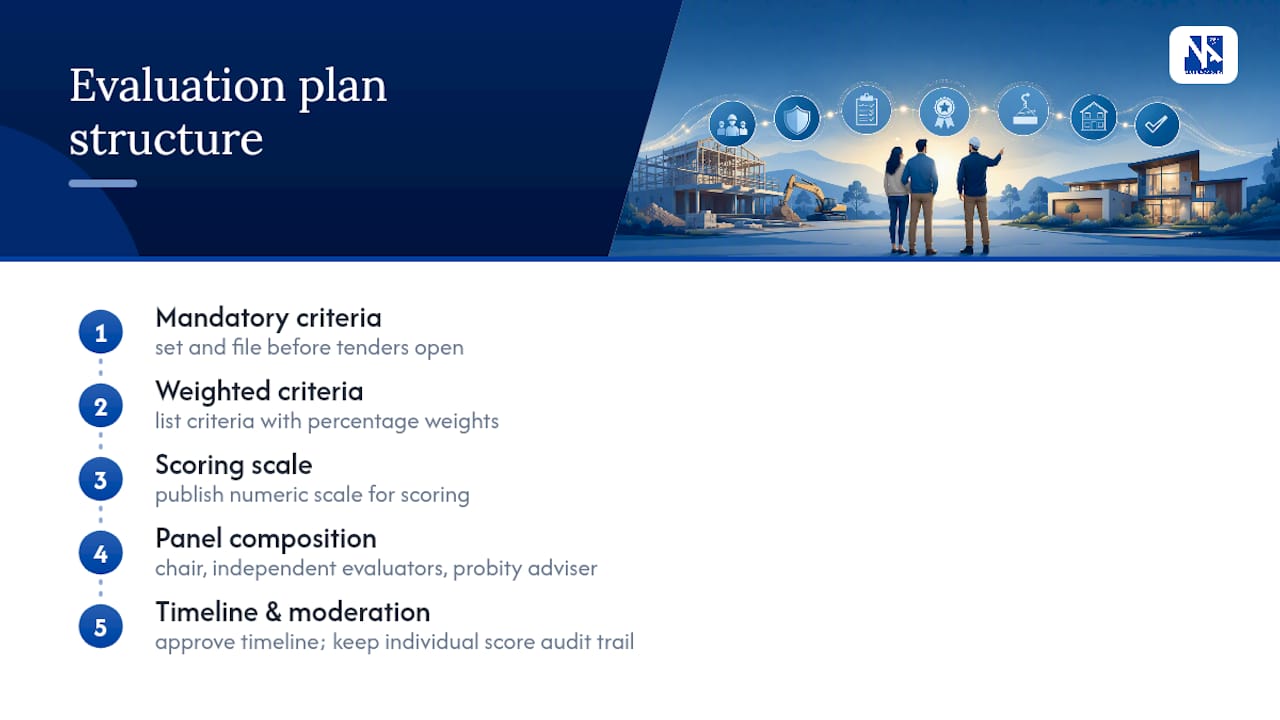
Panel roles need clear separation of duties. A chair manages process and timing but shouldn’t unduly influence individual scores. Individual evaluators score independently against the published criteria, each covering the areas matching their expertise, whether that’s construction methodology, commercial terms, or WHS compliance. A probity advisor, either internal or external depending on contract value, reviews the process for fairness and flags any conflict of interest before scoring starts.
Conflicts of interest need declaring in writing before evaluators see a single bid, not discovered halfway through scoring. A panel member with a prior working relationship with a tenderer, a financial interest, or even a personal connection to a bidder’s staff should recuse themselves from scoring that submission, and the recusal should be documented.
Independent scoring, meaning each evaluator marks separately before any group discussion, protects against groupthink and anchoring bias, where the first opinion voiced in the room quietly shapes everyone else’s scores. Keep every individual score sheet on file, even after moderation changes a number, because the audit trail needs to show what changed and why, not just the final figure.
What common mistakes derail a builder tender evaluation?
The most frequent failure is scoring bids against criteria that were never disclosed in the tender documents, which immediately exposes the process to a fairness challenge from an unsuccessful tenderer. Every criterion used to rank submissions, along with its relative weighting, needs to appear in the tender documents before bids are invited, not introduced afterward to justify a preferred outcome.
A second common problem is skipping mandatory checks and moving straight to scoring, which risks carrying a non-compliant builder through the entire process before someone notices the missing insurance certificate at award stage. Screen every mandatory item first, record the pass or fail decision with its evidence, and only score the compliant bids.
Poor levelling is the third recurring trap: comparing headline prices without checking that provisional sums, exclusions and assumptions cover identical scope. Two bids $200,000 apart can flip order entirely once you adjust for one builder excluding site services the other included.
Generic, boilerplate methodology responses cause real damage too, because evaluators sometimes score based on how professionally a document reads rather than how specific its evidence is to your project. A polished but generic programme should score lower than a rougher one that names actual hold points and sequencing for your site.
Finally, failing to normalise non-price scores before applying weightings is a technical error that quietly mis-ranks tenders. If the highest non-price scorer gets 8.5 out of 10 and you apply weightings to raw scores rather than normalised ones, small gaps in low-weighted criteria can distort the outcome more than a significant price difference should.
Legal and regulatory considerations affecting tender evaluation
Procurement guidance treats disclosure as a legal expectation, not a courtesy: agencies must set out evaluation criteria and mandatory conditions in the tender documents themselves, and departing from that disclosed process without justification exposes the buyer to challenge from unsuccessful tenderers.
Value for money obligations extend beyond price. Government procurement rules require officials to weigh whole-of-life costs and non-financial benefits rather than defaulting to the lowest bid, which is precisely why a documented rationale matters when a higher-priced tender wins.
Industrial relations compliance carries its own threshold rules in several jurisdictions, where contracts above a set value must confirm the builder meets Fair Jobs Code or equivalent obligations before award, checked as a mandatory criterion rather than left to a general compliance assurance.
Social procurement obligations increasingly carry legal weight too. Some public buyers now set minimum weightings for SME and local participation on larger contracts, meaning a bid that ignores those criteria can fail on compliance grounds even with a competitive price. Private sector buyers aren’t bound by these specific rules, but the same discipline, disclosed criteria, documented mandatory checks and a defensible audit trail, protects against contract disputes and rework claims down the track.
Examples of best practice tender evaluation frameworks
The weighted criteria model published for building works and services remains the most widely referenced framework in Australian construction procurement, largely because it sets out the normalisation method step by step rather than leaving evaluators to invent their own scaling approach.
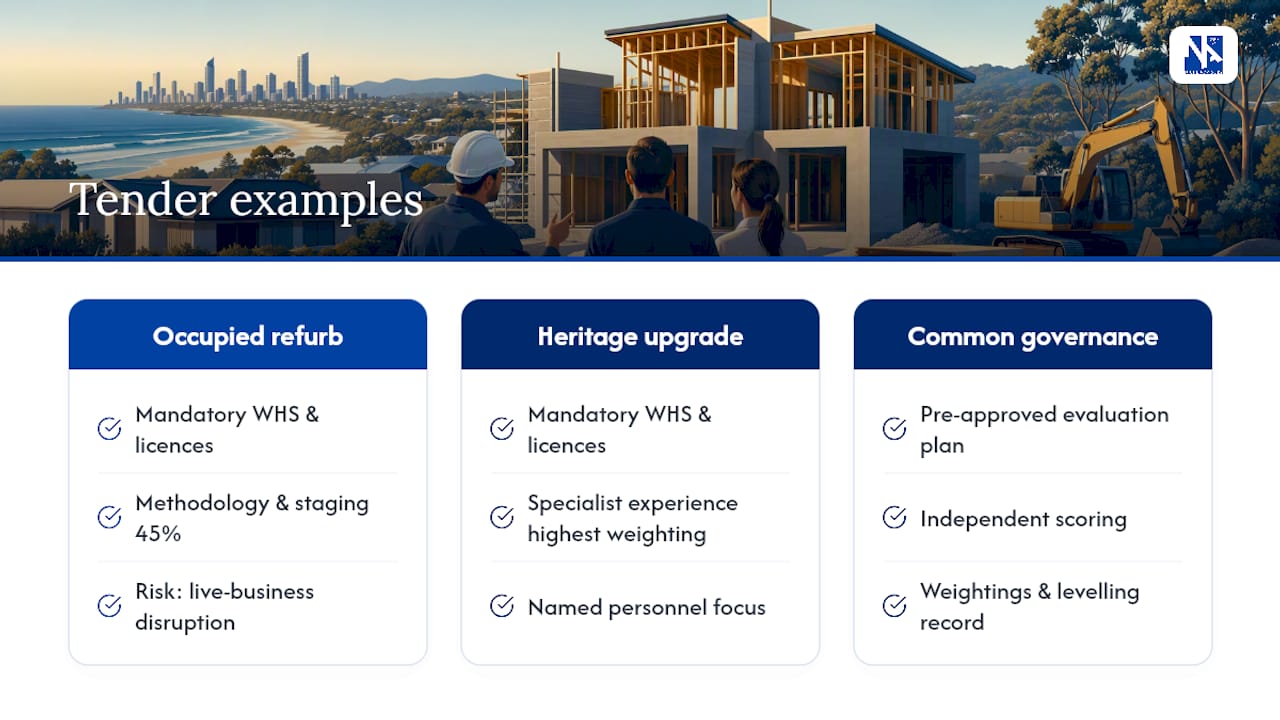
A well-run occupied refurbishment tender illustrates the framework in action: mandatory criteria screen out builders without current WHS plans or relevant licences, then methodology and staging sequencing carry 45% of the non-price weighting because disruption to a live business is the dominant risk, well ahead of the builder’s general project experience.
A base building upgrade on a heritage-listed site shows the opposite emphasis: specialist experience and named personnel carry the heaviest non-price weighting, because compliance risk sits with the individuals doing the work, not the company’s general capability statement.
Both examples share the same governance backbone: an evaluation plan approved before tenders opened, independent scoring, and a report that documents every weighting decision and levelling adjustment. That consistency across very different project types is what makes a framework defensible rather than just convenient.
If your organisation is running a tender for premises you occupy as a tenant, aligning your evaluation criteria to your actual workplace strategy before the tender opens avoids a mismatch between what you scored and what your business actually needs from the finished space. Nicheadvisory’s corporate real estate and project and construction management teams work exclusively for tenants and owner-occupiers, never landlords, which means the evaluation criteria and weightings we help set are built around your operational outcomes rather than a contractor’s convenience. Where site condition and existing building risk affect how you weight methodology, a pre-tender condition assessment can sharpen those criteria before you issue the tender, and independent tenant advocacy during the process keeps the evaluation focused on your interests rather than the builder’s.
Templates and policy guidance worth keeping on file
Keep the weighted criteria guidelines and NSW evaluation criteria guidance bookmarked for scoring templates and social procurement thresholds. For specialist subcontractor verification during evaluation, engineering capability checks help confirm technical claims before award.
Sources
- Evaluation criteria (Construction Guidance 3.7)
- Guidelines on Tender Evaluation using Weighted Criteria for Building Works and Services (Version 8)
- Tender evaluation: practical guide (Procore AU)
- Tender evaluation in construction: Process, Scoring, & Compliance
- Tender evaluation criteria | info.buy.nsw
FAQ
How Do You Evaluate a Tender?
You evaluate a tender by screening every submission against mandatory criteria first, then scoring the compliant bids against pre-published weighted criteria covering price and non-price factors. Non-price scores get normalised to the highest scorer, price is scored against the lowest bid, and weightings are applied to produce a final ranking.
What Is the 80/20 Rule for Tenders?
There’s no single official rule splitting price and non-price weightings for builder tender evaluation, and definitions vary between organisations.
What Are the Six Criteria of Evaluation?
There’s no universally fixed list of six evaluation criteria in Australian construction procurement, though most tender evaluations cover a similar core set: price, methodology, experience and past performance, the proposed team, management systems (WHS, quality, environmental), and social or local participation commitments. The exact criteria and their number depend on the specific tender and buyer.
What Is Tender Evaluation Criteria?
Tender evaluation criteria are the specific factors, and their relative weightings, that a buyer uses to compare and rank competing bids, disclosed in the tender documents before submissions open. They typically split into mandatory pass/fail requirements and weighted criteria covering price, methodology, experience and, increasingly, social or economic participation.