
FM service levels are the written standards for what your facilities management provider does, how fast, how often and how you will know. In a leased office or warehouse they only work when they line up with your lease: the landlord’s building services, your own FM contractor and your fitout obligations all need to point at the same standard. We act only for tenants and owner-occupiers, so this guide is written from the occupier’s side of the table.
TL;DR
- An FM service level states quality, quantity and timing in terms users understand. The service level agreement (SLA) is the document that holds them.
- A usable SLA names each service, who delivers it, how often, how you request it, and how variations are priced.
- Separate the SLA (the standard for each job) from the KPI (how often the standard is met over a period).
- Tenants have two layers to align: the lease and the FM contract. Gaps between them are where cost and disputes appear.
- Moves, adds and changes (MAC) and churn need their own service levels, because they are where hybrid work puts pressure on FM.
Table of Contents
- What FM and service levels mean
- Why tenants face two layers of service levels
- What a facilities management SLA should contain
- SLAs and KPIs are not the same thing
- Measuring service levels in a leased workplace
- Moves, adds and changes: a service level of its own
- Churn management for hybrid workplaces
- Aligning service levels with your lease and your strategy
- Where Niche Advisory fits
- Common mistakes to avoid
- FAQ
- Sources
What FM and service levels mean
FM stands for facility management (or facilities management). IFMA, adopting the ISO 41011 definition, describes it as an organisational function that integrates people, place and process within the built environment to improve people’s quality of life and the productivity of the core business.
A service level is the measurable promise inside that function. The RICS Strategic FM Framework describes SLAs as statements about quality, quantity and timing that matter to end users. It adds that they form the basis for decisions on staffing, resources, training and, in the end, the cost of the service.
That last point matters to anyone paying rent and outgoings. Every service level you tighten has a price, and every one you leave vague is a future argument. Setting levels is a cost decision as much as an operations one.
Why tenants face two layers of service levels
If you own your building, one FM contract covers most of what you need. If you lease, there are usually two sets of obligations:
- The landlord’s layer. Base building services such as lifts, common areas, fire systems, air conditioning plant and cleaning of shared areas. You pay for these through outgoings, but the landlord or its property manager controls the contractors.
- Your layer. Services inside your tenancy: reception, tenancy cleaning, workplace helpdesk, furniture and fitout maintenance, moves and changes, security passes, waste and sometimes air conditioning within the premises.
Problems appear at the boundary. A cold floor can be a landlord plant fault, a tenancy diffuser fault or a controls issue, and each has a different responsible party and response time. If your FM contractor is measured on a four-hour response but the fault sits in base building plant, the contractor can meet its SLA while your staff stay cold.
Before you write or renegotiate a single service level, map who is responsible for what, using the lease itself. A lease audit is the cleanest way to do that: it pulls the repair, maintenance, outgoings and make-good obligations into one list that your FM scope can be matched against.
What a facilities management SLA should contain
The RICS guidance is specific about content. An FM SLA should set out:
- what will be done;
- the quantity or volume of service, and any constraints;
- who is responsible for delivery;
- when, or how often, it is delivered;
- who funds it;
- how to obtain it on demand;
- how to obtain variations in quality, quantity or timing, and how those are paid for.
RICS also says SLAs should be agreed between the facility manager and senior management or the buyer, published so users know what to expect, kept concise enough for non-specialists, and reviewed at planned intervals. It cautions that target measures should not sit inside the SLA itself: they can be derived from the contract, the service specification and the SLAs together.
In practice, a one-page service sheet per service line works well. Cleaning, helpdesk, planned maintenance and moves each get their own sheet that an office manager can read in two minutes.
Response time versus fix time
The most common weakness in a contract is measuring only the first response. Facilio’s template guidance notes that separating response time from fix time stops a contract being met on paper while the heating is still off. Write both, and write when the clock starts: at the moment you log the request, not when a technician is dispatched.
Priorities with worked examples
Tiered priorities remove arguments about what counts as urgent. One published example from an FM operations guide uses four tiers: critical work with a 15-minute response and two-hour resolution, high priority at 30 minutes and four hours, medium at two hours and one business day, and low at one business day and five business days. Treat these as a structure to adapt, not a standard. Your own tiers should reflect your operation: a pharmaceutical warehouse with temperature-controlled storage has a different definition of critical from a professional services office.
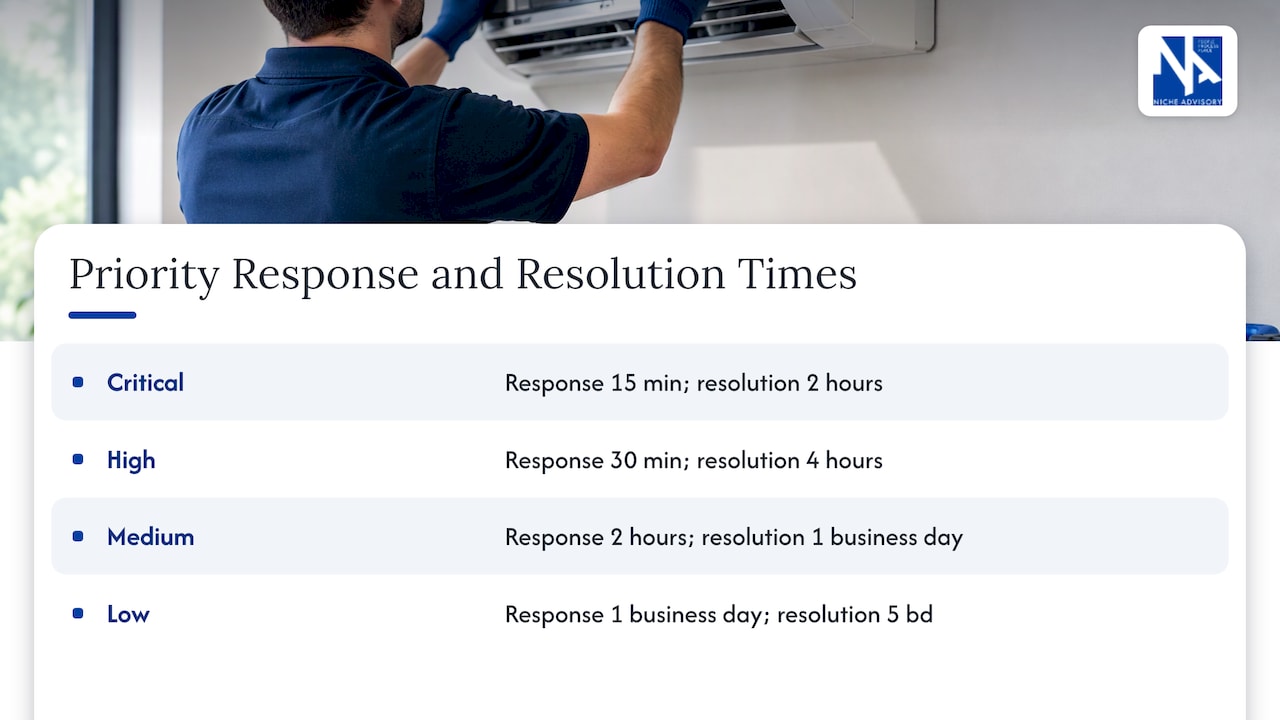
Whatever tiers you choose, give each one a plain example from your own premises (a failed door lock on the main entry, a flickering light in a meeting room) so nobody has to interpret the label.
Exclusions and what happens on failure
Facilio’s guidance warns that an unstated exclusion is read as included by whichever side it suits. List exclusions, such as damage caused by occupants or work that belongs to the landlord.
Also decide what happens when performance slips. SiteClara’s FM SLA guidance describes service credits as a lever, not a management system, and recommends that the contract specify a corrective action plan with dates, escalation to senior people on both sides and termination rights where underperformance continues across more than one period. For an Australian tenant, an agreement attached to the facilities contract is also where Sprintlaw’s Australian guide suggests putting response times, planned maintenance cycles and cleanliness standards, so that performance can be monitored and enforced.
SLAs and KPIs are not the same thing
The two terms are often used as if they were interchangeable. They do different jobs.
| SLA | KPI | |
|---|---|---|
| What it sets | The standard for each piece of work | How often the standard is met over a period |
| Example | A priority-one fault made safe within an agreed time | Share of priority-one faults made safe on time this month |
| Who uses it | Service users and the provider | Management and the buyer |
| Reviewed | At planned intervals | Monthly or quarterly |
This distinction follows SiteClara’s guide, which also notes that KPIs can track occupant satisfaction, repeat calls and the ratio of planned to reactive work.
Pick few KPIs. Four or five that you actually read each month beat fifteen nobody opens. A sensible starting set for a tenant:
- priority-one and priority-two on-time rate;
- planned maintenance completed inside its scheduled window;
- first-time fix rate;
- repeat calls for the same fault;
- occupant satisfaction from a short pulse survey.
Figures published online as industry benchmarks, such as preventive maintenance compliance above 95% or a first-time fix rate above 80% in one KPI design guide, are a reasonable conversation starter. Set your own targets from your site, your staff and what you are prepared to pay for.
Measuring service levels in a leased workplace
A service level you cannot measure is a wish. Three habits make measurement dependable:
- One logging channel. Requests come through a single helpdesk or system, so each has a timestamp for logging, acknowledgement, arrival and completion.
- Reports tied to the SLA. The monthly report uses the same priority labels and times as the SLA, so there is no translation.
- A regular review. A quarterly meeting with the provider, and where relevant the landlord’s property manager, to look at trends and repeat faults, not just last month’s numbers.
Australian FM software suppliers, such as SWG’s QFM, describe the same logic: monitor delivery in real time, track contractor performance and cost, and use contract management to measure against contractual service levels and increase cost control.
For tenants, add one more column to the review: who was responsible under the lease. A repeated fault that belongs to base building plant should be escalated to the landlord, using the lease as the basis, rather than counted against your FM provider.
Moves, adds and changes: a service level of its own
Moves, adds and changes (MAC) covers relocating people, adding workstations or changing layouts inside your tenancy. It is the service line that hybrid work grows fastest, because team sizes and attendance patterns change often.
The Wiley Facilities Manager’s Desk Reference says organisations need a process for managing requests for internal moves. It notes that planning and approvals may take longer than the move itself, and that some organisations keep 5 to 10% of total space empty to allow quick relocation or restacking. It also advises following up after a move, including clearing crates, boxes and packaging waste.
A workable MAC process looks like this:
- Request. The manager submits a move request through the single channel, with names, locations and the date needed.
- Approval. A named person checks the request against the space plan and budget.
- Planning. Furniture, IT, cabling, security access and signage are scheduled, with a lead time agreed in the SLA.
- Communication. Move management guidance stresses keeping employees informed through clear, timely updates so that confusion does not cost productivity.
- Execution. The physical move happens, ideally out of hours, with progress tracked.
- Close-out. Waste is removed, the floor plan and asset register are updated, and the requester confirms completion.
The service level then covers the lead time for a standard move (for example, a set number of business days’ notice for up to a given number of people), the price basis for each type of change, and the rate for urgent requests. Putting that price basis in advance is what the RICS guidance means by agreeing how variations are obtained and paid for.
Moves inside the lease
Some changes touch the lease. Adding partitions, altering ceilings or changing services may need landlord consent and may create make-good obligations at the end of the term. Check the make-good position before approving a large layout change, so you know what must be reinstated when you leave.
Churn management for hybrid workplaces
Churn is the relocation of people between workpoints. The Australian Government’s Department of Finance guidance, Resource Management Guide 506, defines it this way and requires property management plans to address staffing forecasts and churn contingencies. It is written for government agencies, but the ideas carry over to any occupier.
The guide lists causes of churn that every tenant will recognise:
- demand factors, such as recruitment, retirements and project teams;
- supply factors, such as a lease ending;
- predictable long-cycle events;
- unpredictable events;
- short-life projects;
- stable areas with little spare space.
Its strategies are useful service-level inputs: track occupancy data, match your operating vacancy rate to how volatile your headcount is, use modular, standardised partitions and interchangeable furniture, engage staff on change, and review timing, communication and user satisfaction after each churn project. It cites one agency that churned 300% of its people in twelve months while moving few workstations, which shows how much a flexible layout can absorb.
For your FM service levels this means a churn schedule that sets:
- how many moves per month are included in the base fee;
- the lead time for each size of move;
- the standard furniture and cabling kit, so moves are repeatable;
- a post-move satisfaction check.
If you are shifting to hybrid work, churn often drops while reconfiguration increases. Our guide to hybrid workplace strategy on the lease side covers how those layout changes interact with lease terms.
Aligning service levels with your lease and your strategy
The most expensive service levels are the ones that do not match the premises. Three alignment checks catch most of the problems:
- Scope versus lease. Does your FM scope cover only what you are responsible for under the lease? Paying twice for a service the landlord already provides through outgoings is common.
- Hours versus occupancy. If your people are in three days a week, cleaning, air conditioning hours and helpdesk cover should reflect real attendance, not the old five-day pattern.
- Term versus FM contract. An FM contract that runs well past your lease expiry or break date locks in costs you may not need after you relocate or downsize. Matching them keeps your options open at renewal.
This is the territory where workplace strategy and lease decisions meet. Service levels follow from how you use space, and how you use space determines which lease you need.
Where Niche Advisory fits
We act exclusively for tenants and owner-occupiers, never landlords, and our advice is independent. Our workplace strategy work links how your people use space to your property decisions. Our lease administration services keep track of lease obligations, and corporate tenant advocacy puts a tenant specialist across negotiations and disputes with landlords. When a fitout or relocation changes your service needs, our project and construction management covers delivery.
If you want your lease obligations and workplace needs reviewed before you set or reset service levels, start at nicheadvisory.com.au.
Common mistakes to avoid
- Copying a template unchanged. A generic SLA reflects someone else’s building. Adapt priorities, hours and exclusions to your premises.
- Putting targets in the wrong place. RICS recommends keeping the SLA readable and deriving targets from the contract, specification and SLA together.
- Ignoring the landlord’s side. Faults that belong to base building services need an escalation route to the property manager, written down.
- Forgetting reviews. SLAs should be reviewed at planned intervals, because occupancy, headcount and hours change.
- No consequence for repeated misses. Credits alone rarely change behaviour. Include corrective plans and escalation.
FAQ
What does FM mean in facilities management?
FM means facility management, the function that integrates people, place and process in the built environment to support people and the core business, according to the ISO 41011 definition adopted by IFMA. In a workplace it covers services such as maintenance, cleaning, security, helpdesk and moves.
What is the difference between an SLA and a KPI in FM?
An SLA sets the standard for each piece of work, such as a response or completion time. A KPI measures how often that standard was met over a period, such as a month. You need both: the SLA tells the provider what to do, and the KPI tells you whether it happened.
What should a facilities management SLA include?
It should state what will be delivered, the volume, who delivers it, how often, who pays, how to request it and how to obtain and pay for changes. Add priority definitions, response and fix times, exclusions, reporting and review dates, and what happens if performance stays below target.
What is a moves, adds and changes process?
It is the routine for handling internal relocations and layout changes: request, approval, planning, communication, execution and close-out. The service level sets lead times and the price basis for each type of change, so requests are handled consistently.
What is churn management in an office?
Churn management is planning for the movement of people between workpoints. It uses occupancy data, standard furniture and partitions, and clear communication to keep moves quick and cheap, and reviews each move afterwards for timing and user satisfaction.
Sources
- What Is Facility Management? IFMA
- Strategic FM Framework, RICS guidance note
- Service Level Agreement Template, Facilio
- Facility management SLA: service levels you can check, SiteClara
- Managing Reactive Work and Response-Time SLAs, OxMaint
- Designing FM SLAs With Measurable KPIs, OxMaint
- Creating Facilities Agreements, Sprintlaw Australia
- QFM CMMS software, SWG
- Facilities Manager’s Desk Reference, Wiley
- What Is Move Management? Kadence
- Resource Management Guide 506, Department of Finance