
A licence to occupy is a contract that lets your business use a space without handing you exclusive possession of it. A lease does hand you that control, and with it an interest in the land. In practice, a licence gives you less security, less control and usually more flexibility. Whether that trade suits you depends on how long you need the space, how much you will spend fitting it out, and how the document is actually written. Courts look at substance, not the label on the first page.
This guide is for business owners, facilities managers and executives who have been offered a licence for office, warehouse or storage space, including overseas companies setting up in Australia. We act only for tenants and owner-occupiers, so the view here is the occupier’s.
TL;DR
- A licence is permission to use space under a contract. A lease gives exclusive possession for a set period and creates an interest in land.
- Calling a document a “licence” does not make it one. If it gives you exclusive possession, a court can treat it as a lease.
- A licence generally offers weaker security of tenure, so avoid it for premises you will invest heavily in.
- Check the licensed area, access, fees and outgoings, GST, term, termination, insurance, make-good and fit-out rights before signing.
- Overseas companies should treat a licence as a short-term entry option, not a long-term base.
Table of Contents
- What a licence to occupy means for a business
- Licence vs lease: exclusive possession is the test
- When a licence makes sense, and when it doesn’t
- What to check in a commercial licence
- Do state and territory rules differ?
- How a licence interacts with other property rights
- Overseas companies: using a licence to enter Australia
- How we help occupiers with licences and leases
- A checklist before you sign
- FAQ
- Sources
What a licence to occupy means for a business
In commercial property, a licence to occupy is an agreement where the owner (the licensor) allows you (the licensee) to use a defined area for an agreed purpose and period, for a fee. The right comes from the contract. It is a personal permission rather than an estate in the land.
The NSW Office of Local Government describes the split plainly: a lease grants exclusive possession for a specified period in return for rent, while a licence is a contractual right to occupy for a licence fee. Victorian council guidance adds the consequence: a lease creates an interest in land that binds third parties, while a licence does not.
You will meet licences in several forms:
- Serviced and flexible offices, where you get desks or a suite with shared reception, meeting rooms and services.
- Shared warehouse or storage space, where the operator can move your pallets or cage.
- Short-term access while a lease is negotiated or a building is being completed.
- Licences over adjacent areas, such as a car park, rooftop or loading dock, alongside a lease of the main premises.
- Council and public land, such as kiosks, market stalls and depots.
One caution on terminology. “Licence to occupy” also appears in residential property sales, where a buyer moves in before settlement, and in retirement villages. Those are different arrangements with their own rules. This article covers commercial premises.
Licence vs lease: exclusive possession is the test
The deciding question is whether you have exclusive possession: the legal right to exclude everyone else, including the owner, from the space. If you do, you almost certainly have a lease. If the owner keeps control, can enter freely, can relocate you or can share the space with others, you probably have a licence.
Australian courts have applied this for decades. In Radaich v Smith, the High Court held that an agreement called a licence created a tenancy because it gave the occupier exclusive possession for the term. The Court also explained that exclusive possession matters most where the business can only operate effectively if the occupier controls the premises.
The principle has been repeated in tax and property disputes:
- In a NSW revenue case, the court stated that the feature distinguishing a lease from a licence is the grant of exclusive possession.
- The Victorian Court of Appeal confirmed that courts examine whether exclusive possession was granted and may classify an instrument as a lease despite its licence label.
- VCAT has looked at the legal substance of an arrangement to decide whether it was a lease or licence, which shows how fact-sensitive the question is.
The practical lesson cuts both ways. A licensor cannot avoid lease obligations simply by choosing a different heading. And you cannot assume you have lease protections because you have your own key and a fixed desk.
A side-by-side comparison
| Feature | Lease | Licence to occupy |
|---|---|---|
| Exclusive possession | Yes | Generally no |
| Nature of the right | Interest in land | Personal contractual permission |
| Binds a new owner | Generally yes | Generally no |
| Payment | Rent | Licence fee |
| Security of tenure | Stronger | Weaker |
| Typical use | Long-term base, major fit-out | Short-term, shared or flexible space |
| Owner’s control | Limited by the lease | Retained, often including relocation |
A lawyer should read the actual document, but the table is a reliable first screen.
Why the difference hits your budget
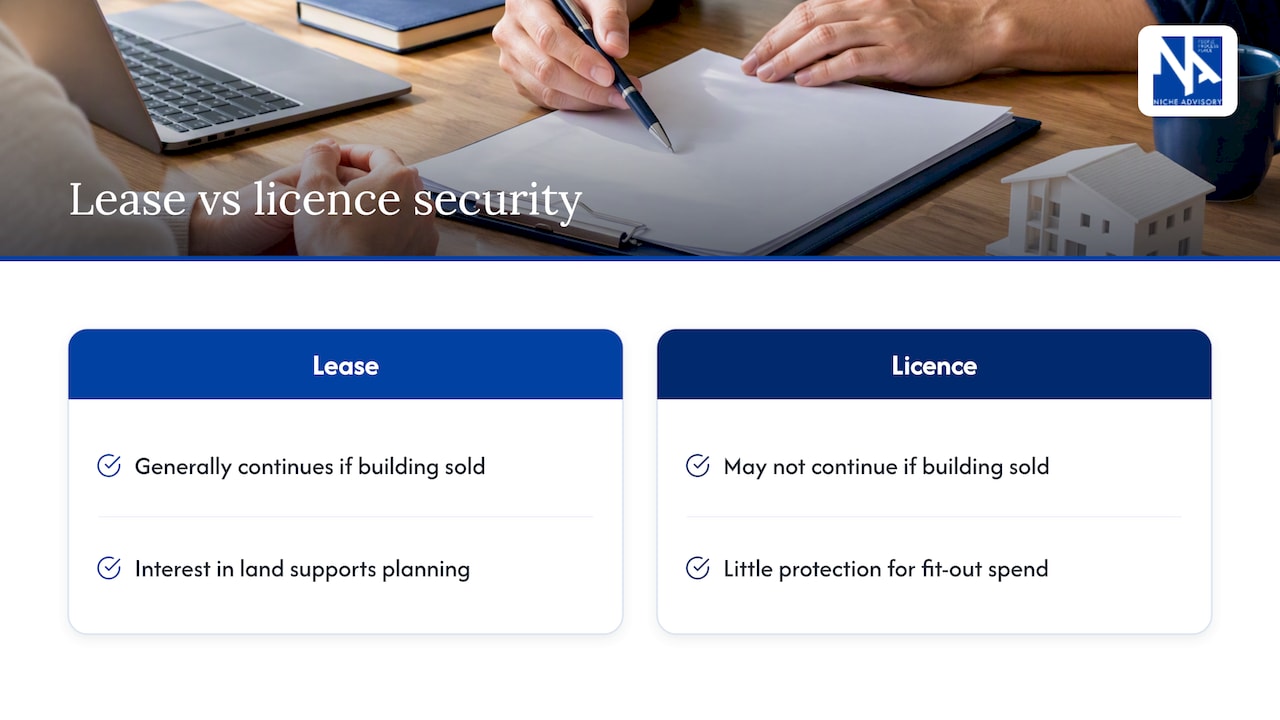
An interest in land is what lets a tenant plan. If the building is sold, a lease generally continues. A licence may not. If you spend on fit-out, cabling, racking or a showroom, the licence gives you very little to protect that spend. Law firm JWS notes that a licence gives less security of tenure, and businesses that need security or exclusive possession should prefer a lease.
That links directly to accounting and payback. If you are weighing how long a commitment should last against what you spend on the fit-out, our piece on matching lease term to fit-out payback under AASB 16 walks through the logic.
When a licence makes sense, and when it doesn’t
A licence is a reasonable choice when flexibility is worth more than control:
- You are testing a new market, a new team or a hybrid model and may change your footprint within a year.
- You need space quickly and a conventional lease would take months to negotiate.
- You need only part of a building, a few bays, or a shared service.
- The space is a stop-gap while a larger move is built.
The flexible-space market is growing in Australian cities. Our analysis of flexible office space in Sydney commercial leases explains where that demand is heading, and our note on flexible office strategy and the shift to working from home covers how it shapes lease choices.
A licence is a poor fit when:
- You are building out premises to suit your brand, systems or machinery.
- You need guaranteed access at all hours, for example for a 24-hour warehouse.
- You need to put the address on regulatory approvals that depend on a stable tenure.
- You want an option to renew at a pre-agreed rent.
- Customers or staff need to rely on your being in the same place for years.
In those cases, a lease with proper renewal options, a defined make-good and a rent review mechanism protects you far better.
What to check in a commercial licence
Most licence problems come from terms that look minor on signing. Abbots Legal lists the rights that typically sit in a licence agreement: the area you operate from, access times, shared facilities, signage, storage, services and the agreed period. Work through each of the following.
The area and the owner’s control
- Is the licensed area identified on a plan, or is it “a desk” or “approximately 200 pallet spaces”?
- Can the licensor relocate you? For how much notice, and at whose cost?
- Does the licensor keep keys and the right to enter at any time?
- Does the document say it does not grant exclusive possession? If you are paying for a private, locked, stand-alone suite, ask why it is a licence.
An Australian licence agreement should state that it does not grant exclusive possession and reserve the licensor’s control. If you want a lease, say so before signing, rather than relying on later argument over labels.
Permitted use, access and shared facilities
Confirm what you can do in the space, when you can get in, and which facilities you share. For warehouse licences, agreements should cover the storage area or method, relocation rights, loading access, permitted and prohibited goods, safety rules and extra services such as pick-and-pack. Dangerous goods, chemicals and fuel often need specific approval. One council licensing policy requires prior approval for construction, service connections and storage of fuel or chemicals.
Fees, outgoings and GST
Ask what the licence fee includes. Some are all-inclusive. Others add power, cleaning, security or a share of building costs. On GST, the ATO treats a licence to occupy land as ‘real property’; where the supply of premises is taxable, GST applies and consideration includes relevant outgoings the occupier pays. In short, check whether the fee is quoted plus GST, and have your accountant confirm the treatment. Separately supplied services may be treated separately.
Term, renewal and termination
This is where licences and leases part ways most. Look for:
- A fixed term, or a rolling arrangement terminable on short notice.
- Any right to renew, and on what price basis.
- Whether either party can end it without cause, and on how many days’ notice.
- What happens to your fit-out, stock and equipment on termination.
A short notice period is the central risk. If a licensor can end the arrangement in 30 days, your business is effectively on a month-to-month footing. Council policies show the sort of default triggers to expect: one states that unauthorised works may have to be removed, the premises reinstated, and the occupancy agreement may be terminated.
Insurance, liability and compliance
Expect to carry public liability insurance and to indemnify the licensor against claims arising from your activities. Public-sector policies commonly require risk management, public liability insurance, emergency procedures and building-condition inspections, and private licensors often ask for similar. Check liability caps, especially for stored goods. Check whether your stock is insured by you or covered, and to what limit, by the operator.
Fit-out, make-good and assignment
Can you install cabling, partitions, signage or racking? Who owns them at the end? Must you restore the space? Make-good obligations are often expensive and sometimes disputed, even where the occupier thought a short licence meant none. Can you transfer the licence if you sell the business? Most licences prohibit it, which can matter in a sale.
If you cannot get these points settled, it is a signal that you may be better off with a lease.
Do state and territory rules differ?
The core exclusive possession test is common law and applies nationally. Differences arise in the regulatory layers around it:
- Retail premises are covered by state retail leasing legislation, and whether a lease is retail or commercial can change your rights. Our guide to four checks for retail versus commercial leases explains how to tell. Do not assume that calling a retail arrangement a licence takes it outside these protections without legal advice.
- Council and community land is subject to its own rules. In NSW, council licences over community land face statutory restrictions, including public consultation and, in specified cases, tender requirements.
- Local government policy varies. Victorian council guidance says a licence or hire agreement may be chosen instead of a lease after considering the property and users’ circumstances, while a Western Australian shire framework describes licences as non-exclusive permissions commonly used where facilities are shared and access is limited to specified purposes and times.
- Exclusive occupation generally brings heavier maintenance and management expectations than a non-exclusive licence, as that same framework notes.
For a wider look at how leasing rules have shifted for tenants, see our breakdown of the new code for commercial leases.
How a licence interacts with other property rights
A licence sits beside, not above, the other rights attached to land. Easements, covenants and title restrictions can limit what any occupier may do, whether under a lease or a licence. For a legal overview, see this explanation of easements and covenants affecting Australian property. Because a licence is personal and does not bind a purchaser of the land, ask what happens if the property is sold or mortgaged, and whether the licensor’s lender has consented to your occupation.
Overseas companies: using a licence to enter Australia
Companies from the UK, US and Singapore often reach for a licence first, and it is a sensible entry step when handled properly.
Where it helps. A licence lets you start trading, hire locally and learn your preferred suburb without a multi-year commitment. Many of our clients start in the Sydney CBD, Parramatta, Macquarie Park or Sydney Olympic Park, and then scale. Compare options in Sydney Olympic Park or Redfern against a licence in a serviced building.
What to watch.
- Do not expect an overseas lease mindset. Terms such as “licence”, “tenancy at will” and “serviced office agreement” do not map neatly between jurisdictions. Australian courts apply the exclusive possession test, not the label.
- Check fit for regulatory registration. If you need a registered local address, confirm the licence meets the requirement.
- Plan for the exit. Know the notice period, the make-good and the deposit return conditions in advance.
- Get GST advice. Treatment may differ from your home market’s rules.
- Set a review point. If you grow beyond the space or want to invest in fit-out, move to a lease before you spend.
An independent adviser acting for you can compare the licence against alternatives in the same suburb and negotiate the terms the operator would rather not offer.
How we help occupiers with licences and leases
We act only for tenants and owner-occupiers, never landlords, so our advice on a licence or lease is independent of whoever owns the building. Our corporate tenant advocacy team can review a licence offer, test whether it should be a lease, run a property search and negotiate terms. If you already hold a lease and a licence side by side, we can help with lease administration and critical dates, renegotiation, exit or make-good. Where an arrangement has gone wrong, our dispute resolution services are there for tenants. To discuss your premises, start at Niche Advisory.
A checklist before you sign
- Read the document for exclusive possession language, and ask whether a lease is the better structure.
- Mark the licensed area on a plan and confirm relocation rights.
- Get the total cost in writing: fee, outgoings, services, deposit and GST.
- Confirm term, renewal and the shortest termination notice either party may give.
- Check insurance, indemnities and liability caps against your own policy.
- Settle fit-out, ownership of improvements and make-good.
- Ask whether the licence is assignable, and what happens if the owner sells.
- Have a property lawyer review it before you sign. Retail premises, council land and significant fit-out are the cases where this matters most.
FAQ
Is a licence to occupy the same as a lease?
No. A lease gives exclusive possession for a set period and creates an interest in land. A licence is a personal contractual permission to use the space. Courts look at substance, so a document called a licence can still be a lease if it gives you exclusive possession.
Does a licensee have any security if the building is sold?
Generally much less than a tenant. A lease is an interest in land that binds third parties, while a licence does not. Ask the licensor what happens on sale, and consider a lease if continuity matters.
What is the difference between an occupant and a tenant?
A tenant holds a lease with exclusive possession and an interest in the land. An occupant under a licence has only the permission the contract gives, and the owner retains control of the space.
Is GST payable on a licence fee?
It can be. The ATO treats a licence to occupy land as real property, and where the supply of premises is taxable, GST applies to it and can extend to outgoings paid by the occupier. Ask your accountant to confirm the position for your arrangement.
Sources
- Leases, licences and other estates, NSW Office of Local Government
- Commercial and community property leasing, Moyne Shire Council
- Radaich v Smith (1959), judgment
- Radaich v Smith (1959), reasons on exclusive possession
- L & T (Sales) Pty Ltd v Chief Commissioner of State Revenue (2007)
- KJRR Pty Ltd v Commissioner of State Revenue [1999] VSCA 2
- NZH Pty Ltd v Mintvale Pty Ltd, VCAT (2017)
- Lease or licence: know the difference, JWS Lawyers
- Licence Agreement Lawyers Melbourne, Abbots Legal
- What Is A Property Licence Agreement?, Sprintlaw
- Storage Warehouse Licences: What to Include, Sprintlaw
- GST Determination GSTD 2000/10, ATO
- Lease and Licence Policy, City of Ballarat
- Property Management Framework, Shire of Donnybrook-Balingup