
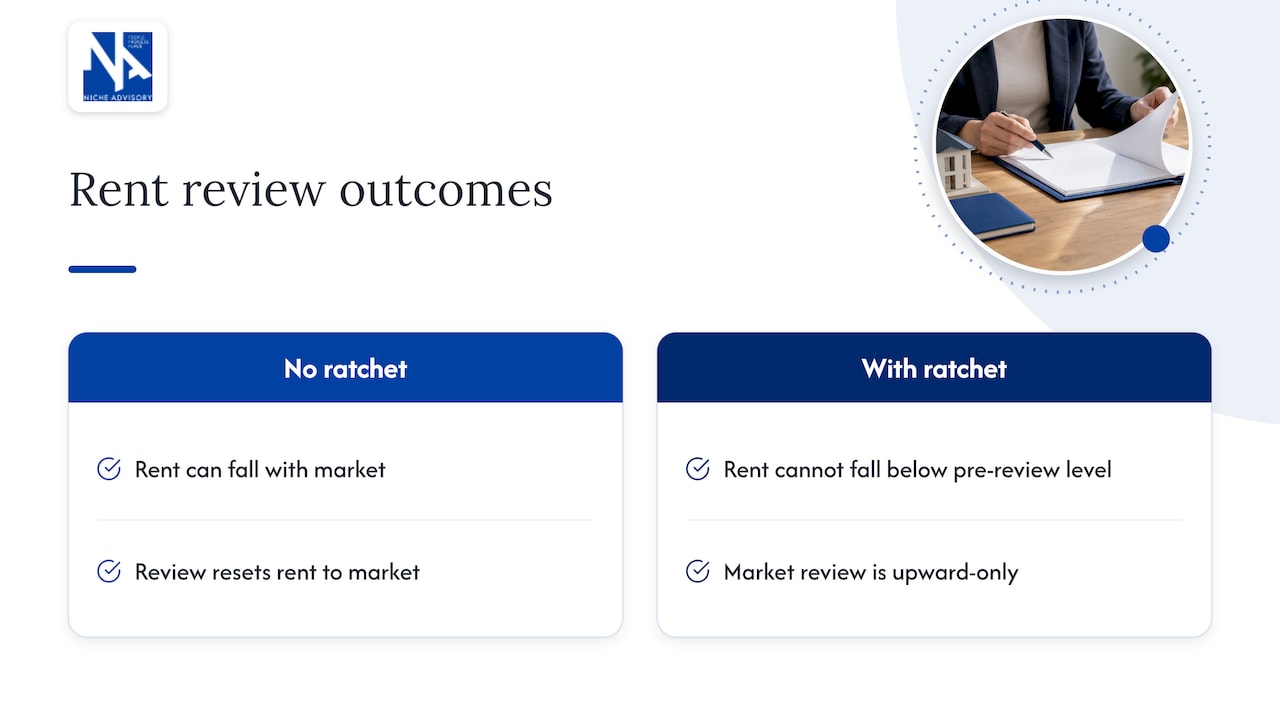
A ratchet clause is a rent review term that stops your rent from going down. At a market review the rent can rise or stay the same, but it cannot fall below what you were paying before, even if the market has softened. In Australian retail leases this kind of clause is generally void. In office, warehouse and industrial leases it is usually legal, so it is something you negotiate before you sign.
This guide explains the meaning, shows a worked example, sets out where the law stops ratchets, and covers how to remove or soften one. It also touches on make good, the other end-of-lease obligation that tenants often fail to price in.
TL;DR
- A ratchet clause means rent can only go up or stay flat at review, never down, even when market rents fall.
- Retail shop leases in most states are protected by legislation that voids ratchets. Office, warehouse and industrial leases generally are not.
- Check whether your premises are legally retail or commercial first. The label in the lease does not settle it.
- Ask for the clause to be deleted, or settle for a collar, a cap or a fixed or CPI review instead.
- Make good is a separate cost at lease end. Negotiate it at the same time as rent review wording.
Table of Contents
- What a ratchet clause means
- Where the law bans ratchet clauses
- Why landlords include them, and why you can push back
- How to negotiate a ratchet clause
- Where a ratchet fits among other lease red flags
- Make good: the other end-of-lease cost
- Getting independent help
- Quick checklist before you sign
- FAQ
- Sources
What a ratchet clause means
A rent review is meant to reset rent to the market at set intervals. A ratchet clause overrides that by providing that the rent after the review cannot be less than the rent immediately before it, as Practical Law describes it. A “market review” with a ratchet is, in effect, upward-only.
The practical effect is that the market downside sits with you. As one Australian legal guide puts it, ratchets shift market downside risk from the landlord to the tenant. From a tenant’s point of view, a properly working market review should let rent decrease if the market has slowed, and a ratchet prevents exactly that.
Ratchets are common. The same firm notes that most leases aim to stop rent decreasing after a market review, unless retail legislation prevents it.
A worked example
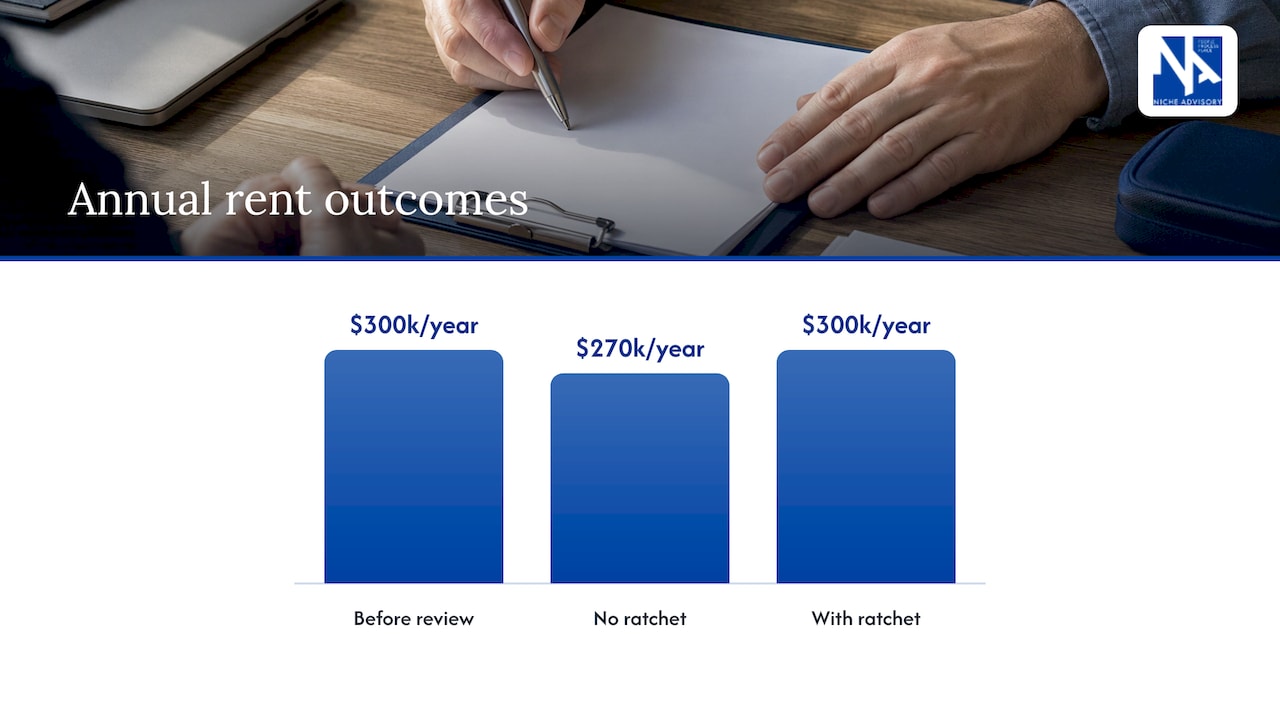
Say you lease 600 square metres of office space at $500 per square metre per year, so $300,000 a year. At the third-year market review, comparable space in your building is now leasing at $450 per square metre.
| Review wording | Rent after review | Annual difference |
|---|---|---|
| True market review (no ratchet) | $270,000 | $30,000 lower |
| Market review with ratchet | $300,000 | No change |
The figures are illustrative only. The point is that the ratchet turns a $30,000 saving into nothing, and the gap compounds if the next review lifts rent from the higher base.
Ratchets can also be written indirectly. A clause might say the reviewed rent is “the greater of” market rent and the current rent, or it might apply a minimum increase each year. Read the review mechanics as a whole, not just a clause headed “ratchet”.
Where the law bans ratchet clauses
Whether you are protected depends on whether your lease is a retail shop lease under state legislation. Each state and territory has its own regime, so the detail differs.
- Queensland: the Retail Shop Leases Act 1994 makes ratchet rent provisions void to the extent they prevent a rent decrease on review. There is an exception where a major lessee gives the prescribed notice. The Queensland Small Business Commissioner’s factsheet confirms that ratchet rent reviews are prohibited under the Act.
- Victoria: under the Retail Leases Act 2003, a provision that prevents or limits a reduction of rent on review is void to the extent it does so, with stated exceptions for certain review bases and formulae.
- New South Wales and other states: retail legislation takes a similar approach in most states and territories, but the exact rule and its exceptions sit in each Act. Confirm the current wording with a lawyer or the relevant small business commissioner.
The key point is that this protection does not extend to most office, warehouse and industrial tenancies. For non-retail commercial leases, ratchets may be permitted and are subject to negotiation and general contract law. If you occupy corporate offices or a distribution warehouse, assume nothing protects you unless the lease says so.
Is your lease retail or commercial?
Many tenants assume they are covered because they run a shopfront, or assume they are not because they have a corporate fit-out. Retail status turns on the use of the premises and the statutory definitions, not on the title of the document. Our guide on how to tell if a lease is retail or commercial walks through four checks. Do that before you decide how hard to push on the ratchet.
Why landlords include them, and why you can push back
Landlords and their lenders like predictable income. A ratchet gives a floor under rent, which supports property valuations and the landlord’s financing. That is a commercial reason, not a legal entitlement, and it is a term like any other.
Your leverage depends on the market. When vacancy is high and landlords are offering incentives, tenants have more room to remove a ratchet. When space is tight, you may need to trade for it. Either way, the clause should be a conscious decision in your negotiation, not boilerplate you accept by default. One Australian property practitioner guide advises that unless the parties have knowingly agreed otherwise, the tenant should try to have ratchet clauses deleted, which is a sensible starting position.
How to negotiate a ratchet clause
Work through these steps in order. Start at the strongest position and move down only if you must.
- Ask for deletion. Request a true market review that can go up or down. Frame it as a fair reset rather than a concession.
- Ask for a collar and cap instead. If the landlord will not delete the ratchet, propose a band: rent can fall by no more than a set percentage and rise by no more than a set percentage. A cap protects you from a sharp jump, and a collar limits how far the landlord will allow the rent to fall.
- Swap the review method. A fixed annual increase or CPI review avoids the market-review question altogether. Our comparison of fixed increase versus CPI shows which suits which tenant.
- Limit where the ratchet applies. Some leases ratchet only at market reviews and not on fixed reviews, or only at the start of an option period. Narrowing the scope is a real saving.
- Model the full term. Run rent across the initial term and every option under a falling, flat and rising market. This shows what the ratchet could cost and what you can trade for its removal.
- Trade it against something else. Incentives, rent-free periods, fit-out contributions and make good limits are all in play. See our steps on landlord incentive negotiation.
Get the wording right too. A clause that says rent will be the market rent “but not less than the rent payable immediately before the review date” is a ratchet. Ask your lawyer to check that the review definition, the valuation process and any “greater of” language all point the same way.
Check how the market rent is determined
Even without a ratchet, a market review can go wrong if the valuation process is vague. Look for who appoints the valuer, what assumptions are made (for example, ignoring your own fit-out and any rent-free period), and how disputes are resolved. In NSW retail leasing, where parties cannot agree a current market rent, the Act provides for a specialist retail valuer and the state guide notes costs can be upwards of $1,500 per party. Commercial leases typically run their own expert determination process, and costs vary with the matter.
Where a ratchet fits among other lease red flags
A ratchet is rarely the only term worth a second look. Review it alongside:
- the review frequency and any minimum annual increase
- option rent terms, which often reset the ratchet floor
- make good and reinstatement wording
- outgoings and who pays for what
- assignment, subletting and exit rights
Our checklist of commercial lease red flags covers twelve clauses to check before you sign, and the commercial lease negotiation checklist sets out a sensible order for the conversation. If you are already in a lease and want out, see the options for exiting a commercial lease.
Term length matters too. A longer term with a ratchet locks in more potential cost, so it helps to match the lease term to your fit-out payback before agreeing review terms.
Make good: the other end-of-lease cost
Tenants who search for ratchet clauses often also ask about make good, and for good reason. Both are clauses that look routine at signing and become expensive later.
A make good clause sets the condition in which you must leave the premises. Victorian guidance gives examples such as removing the fit-out, repairing damage beyond fair wear and tear, or returning the premises to their condition at the start of the lease. Many commercial clauses go further and require a return to a bare “base building” configuration, which can include removing partitions and cabling, reinstating ceilings and floors, and certifying services.
Negotiate make good before you sign
The NSW Small Business Commissioner notes that make good disputes often arise because leases do not always state clearly what is required. The same page says what is required can be changed by agreement, for example where the landlord is happy for an internal partition to stay because the next tenant may want it.
Useful points to raise early:
- Define the end condition precisely, with a schedule of what stays and what goes.
- Record the existing condition at the start, with photographs and a condition report.
- Ask for fit-out you install with landlord approval to be exempt from removal where possible.
- Agree a cash settlement option in place of physical works, if that suits you.
- Ask for an early inspection before expiry. Victorian guidance recommends an early inspection and written confirmation if the landlord says no changes are needed.
For detail on how this plays out, see our guides to Sydney commercial lease make good obligations and warehouse and industrial make good negotiations.
Getting independent help
We act exclusively for tenants and owner-occupiers, never landlords. That means our advice on rent review wording, ratchets, make good and incentives is built around your occupancy cost and your business plan. Our corporate tenant advocacy team supports property search, lease negotiation, renewals and reviews, and our dispute resolution services assist when tenants and landlords disagree about rent or make good. If you want to review a lease before you sign or at renewal, talk to us through our main site.
We are not a law firm. Have a property lawyer confirm the legal effect of your lease wording and which statute applies.
Quick checklist before you sign
- Confirm whether the lease is retail or commercial under your state’s legislation.
- Find every review clause: market, fixed, CPI and option reviews.
- Search for “not less than”, “greater of” and minimum increase language.
- Model rent across the term under three market scenarios.
- Ask for deletion, then a collar and cap, then a different review method.
- Settle make good scope and end condition in the same negotiation.
- Have your lawyer check the final wording.
FAQ
What is a rent ratchet clause?
It is a lease term that stops rent falling at a review. The reviewed rent cannot be less than the rent payable just before it, so a market review becomes upward-only in practice. It protects the landlord’s income and moves market downside risk to the tenant.
Are ratchet clauses legal in Australia?
It depends on the lease type and state. In retail shop leases, legislation such as Queensland’s Retail Shop Leases Act 1994 and Victoria’s Retail Leases Act 2003 makes them void to the extent they stop rent decreasing. In non-retail commercial leases they are generally permitted if the tenant agrees to them.
Can I get a ratchet clause removed from a commercial lease?
Often yes, if you ask before signing. Request a true market review, and if the landlord refuses, propose a collar and cap or a fixed or CPI review. Incentives and lease term are common trade-offs.
Does a ratchet clause apply to option periods?
It can. Many leases apply the same review wording at each option, so check the option clause as well as the main review clause. Model the rent across all options, not only the initial term.
How is make good connected to rent review negotiations?
Both are cost items that sit in the same lease and the same negotiation. Tenants can trade one against the other, for example by accepting a narrower review concession in return for a clearer, lighter make good schedule.
Sources
- Ratchet clause, Practical Law
- Ratchet Clauses in Commercial Leases, Sprintlaw
- Leasing market reviews, Russell Kennedy
- Retail Shop Leases Act 1994 (Qld)
- Annual rent increases and market reviews, Queensland Small Business Commissioner
- Retail Leases Act 2003 (Vic)
- NSW Retail Tenancy Guide 2022
- Preparing for end of lease, Victorian Small Business Commission
- Dispute about your lease or bond, NSW Small Business Commissioner
- Law Update, Hunt & Hunt