
A superintendent is a role created by the building contract, and it exists to administer that contract and certify the builder’s claims. A project manager is the person who plans, budgets and drives the project for the business that is paying. On a tenant’s office or warehouse fitout, relocation or make good, the two jobs pull in different directions, and knowing which one is looking after your interests decides how well you are protected. Our project and construction management service acts exclusively for tenants and owner-occupiers, never landlords, so the advice below is written from your side of the table.
TL;DR
- The superintendent is named in the building contract. They give instructions, certify progress claims, value variations and decide extensions of time.
- The project manager plans, monitors and reports for the business. The role is usually not prescribed in the contract and varies between organisations.
- On many Australian commercial jobs one person holds both titles. On larger or more complex projects, separating them gives clearer accountability and better records if a dispute arises.
- The superintendent has to act honestly, fairly and impartially when certifying, so they are not a substitute for someone who protects your commercial position.
- Tenants running a fitout, relocation or make good should decide early who plays each role, and write it into the contract.
Table of Contents
- The short answer: contract role versus business role
- What a superintendent actually does
- What a project manager does
- Side-by-side comparison
- When one person holds both roles
- How the two work together on programme and budget
- Which role does a tenant actually need?
- Records protect you either way
- The pressure on site-based roles
- Moving from superintendent to project manager
- Getting both roles right on your project
- FAQ
- Sources
The short answer: contract role versus business role
The confusion comes from treating both as job titles on a site. They are not the same kind of thing.
Under Australian Standard building contracts such as AS 4000 and AS 2124, the Superintendent is not a party to the contract but a person named in it by the Principal and the Contractor. The Principal is the party paying for the work, which on a fitout is usually the tenant. The same guidance notes that AS 4000 requires the Principal to make sure a Superintendent exists at all times, and that the role is fulfilled reasonably and in good faith.
A project manager has no such standing. Australian contract guidance describes the project manager as generally overseeing planning, monitoring and reporting for the business, with a role that is usually not prescribed in the construction contract and may vary by employer.
So the superintendent answers to the contract. The project manager answers to the business that hired them.
What a superintendent actually does
The core functions under the Australian standard forms, as set out in a paper on the role of the Superintendent, are:
- assessing progress claims and issuing progress certificates
- valuing variations
- determining extensions of time
- assessing the quality of materials and workmanship
- assessing other claims for extra payment, such as latent conditions (problems hidden in the building that nobody could reasonably see before work began)
The same guidance says a superintendent typically supervises site activities daily and administers the contract, including certification and communication between principal and contractor. That daily presence gives them direct influence over workmanship and materials, whereas a project manager may not attend site every day.
The dual role, and why it matters to a tenant
The superintendent wears two hats. They act as the Principal’s agent when giving instructions and directing variations. They also act as an independent assessor when certifying the contractor’s claims, and in that capacity they must act honestly, fairly and impartially. A 2026 Australian guide adds that a principal who interferes with the superintendent’s certifying decisions can expose itself to a claim from the builder.
That has a practical consequence. If you assume your superintendent is simply “on your side”, you may be disappointed when they certify a payment or an extension of time you wanted to resist. The role is designed to be even-handed. Contractors often allege bias towards the Principal when disputes arise, and the role is principally about deciding the major issues of potential dispute between the two parties.
The commercial advocacy, the budget and the business outcome need a different person.
What a project manager does
Jobs and Skills Australia’s construction project manager profile describes the work as planning, organising, directing, controlling and coordinating construction projects and their resources. Listed duties include managing objectives, budgets and schedules, interpreting drawings and specifications, negotiating with stakeholders, and coordinating people, materials and equipment.
Master Builders Australia’s 2025 career guide frames the aim as delivering projects on time, within budget and to design, safety and legal requirements, while coordinating engineers, architects, contractors, tradespeople and clients.
For a tenant, the project manager is the person who asks whether the project is on budget, whether the programme still lines up with the lease expiry or the move-in date, and whether the design is still serving the workplace strategy. That is the business side of the job.
Side-by-side comparison
| Question | Superintendent | Project manager |
|---|---|---|
| Where the role comes from | Named in the building contract | Appointed by the business; not usually prescribed in the contract |
| Who they serve | The contract, acting as agent and as independent certifier | The organisation that hired them |
| Typical focus | Certification, variations, extensions of time, quality | Planning, budget, schedule, reporting, stakeholders |
| Time on site | Typically daily oversight | Varies; may be on or off site |
| Stance in a dispute | Must act fairly between both parties | Advocates for the project and the client’s interests |
| Key risk if neglected | Weak records, contested certificates | Cost and programme drift |
The split on the ground is simple. One industry comparison puts the superintendent on daily site operations, subcontractors, safety and quality, and the project manager on planning, budgets, resources, progress tracking and closeout.
The Fair Work Ombudsman draws a similar line in its award coverage guidance. Site superintendents, supervisors and forepersons directly supervise employees on site, carry work health and safety responsibility and coordinate day-to-day operations. Construction project managers are responsible for projects and may be on site or off it.
Note that this employment-law meaning of “superintendent” is the site-supervision one. In a contract it means the certifier. Always check which one a document is using.
When one person holds both roles
On most commercial Australian jobs, the project manager also performs the Superintendent role under the building contract, and that brings its own contractual obligations. It is common, and on a straightforward fitout it can work well.
On larger or more complex projects, separating the two gives clearer accountability and more defensible records if a dispute arises. A multi-floor headquarters fitout, a warehouse build with heavy services, or a staged relocation with a hard lease deadline are the kinds of jobs where that separation earns its keep.
The trade-off is conflict. A combined role asks one person to push hard for your budget and programme, then switch to impartial certifier on the same afternoon. If you want the person driving your commercial outcome to stay in that lane, appoint someone else as superintendent, or confirm in writing how the combined role will be run.
How the two work together on programme and budget
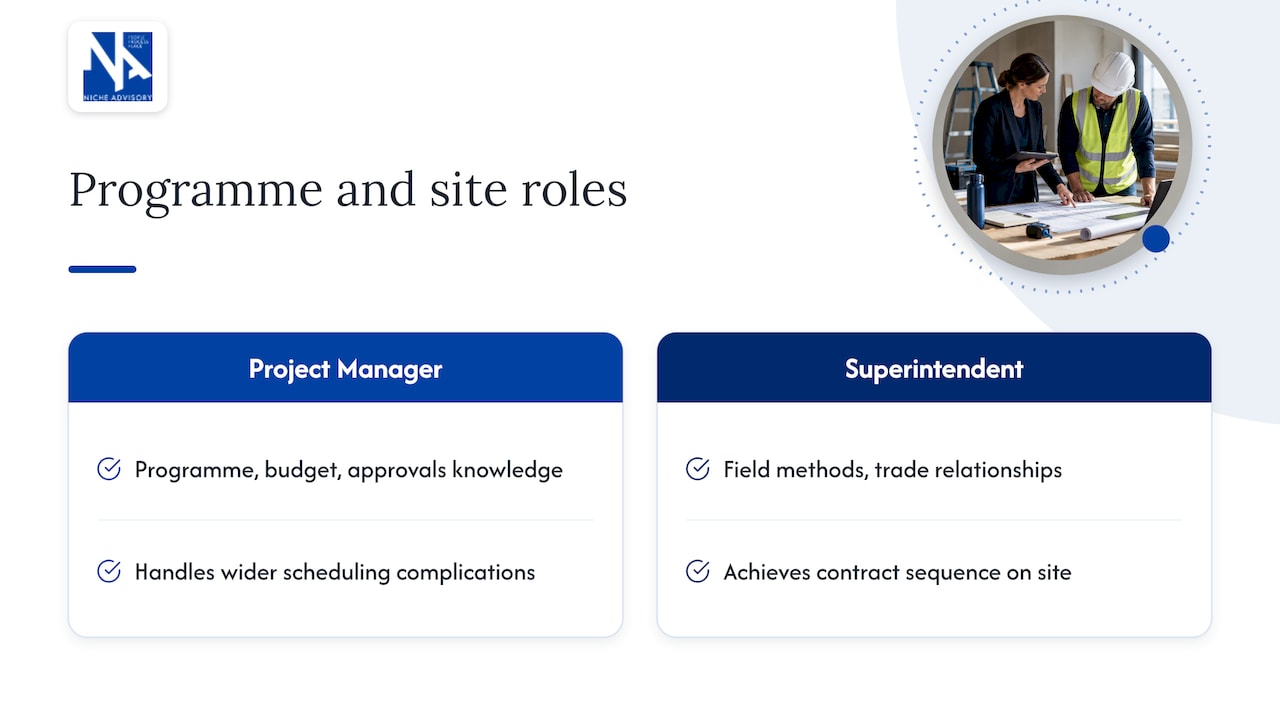
The roles meet at the schedule. The project manager holds the master programme, budget and approvals knowledge. The superintendent brings field-method knowledge and the working relationships with trades. Regular, sometimes daily, meetings help them track progress, resolve issues and prepare the next phase.
Sequencing is shared ground. The superintendent typically makes sure the contract sequence is achieved on site, while the project manager deals with the wider scheduling complications.
A good habit on fitouts is a rolling lookahead. A guide to the Last Planner System notes that lookahead planning commonly examines a three-to-six-week window to find constraints such as missing materials, unresolved design, access, inspections and approvals before work is committed. For a tenant, the access and approvals items often matter most: building management hours, loading dock bookings, landlord consents and certifier inspections can stall an otherwise ready site.
If you want a closer look at how the commercial side is set up before a builder starts, our guides on which construction contract type suits your project and builder tender evaluation cover the decisions that sit upstream of both roles.
Which role does a tenant actually need?
Most tenants need both functions covered, whoever fills them.
- Someone to represent you commercially. This is the client-side project manager: scope, budget, programme, the builder’s claims as they affect you, and how the works connect to your lease obligations. Our guide to the client-side project manager covers the duties and how to appoint one.
- Someone to administer the contract. This is the superintendent: instructions, certificates, variations and extensions of time, with the records to back each decision.
- Someone to hold the builder to the standard at the end. Practical completion is where defects get argued. Our practical completion defects checklist shows what to have agreed before you reach that point.
- A plan for the end of the lease. Make good obligations can turn a modest fitout into a large exit bill. See make good costs in Australia when you set the scope.
Where you assess a build for quality, the same eye for detail applies to new premises as to a home. This build quality checklist from a civil engineer shows the kind of inspection mindset that makes a site walk more useful.
Overseas companies setting up an office in Australia, whether from the UK, the US or Singapore, should note that the superintendent concept comes from Australian Standard contracts and may not look like the engineer or contract administrator roles they know at home. Ask early which standard form the builder proposes and who is named in it.
Records protect you either way
The superintendent’s decisions are only as good as the paperwork behind them. Instructions, variations, claims and certificates all need a trail that shows who decided what and when. That is why separated roles produce more defensible records: each person’s decisions are visible and distinct.
Set up document control before the first instruction is issued. Our construction document control guide explains what it is and where to start.
The pressure on site-based roles
Both roles carry strain. A Western Sydney University systematic review found stress was the most common psychological distress among Australian male construction workers, and that tight deadlines create more stress for higher-management roles such as site supervisors, project managers and construction managers than for general trade workers.
A NSW government evaluation of flexible work on construction sites, published in July 2024, found that more than half of respondents across three sites still reported working over 50 hours a week, because contractual requirements pushed site teams past standard hours or risked financial penalties.
For a tenant, the lesson is practical. A programme with no float, a vague scope and late design decisions land on the people running the site. QUT research summarised by CEDA points to contract pressure, poor physical environment and lack of co-worker support as root drivers of other psychosocial hazards for site-based supervisors. A realistic programme and clear roles reduce those pressures, and they also protect your delivery date.

Moving from superintendent to project manager
This is a different reader’s question, so briefly: a site-side career can lead into project management, but titles differ between employers. A pathway guide from an Australian industry source says supervisors are typically strong in sequencing and crew leadership, with whole-project planning, cost and stakeholder decisions as the growth areas. Relevant qualifications listed by Master Builders Australia include the Diploma of Building and Construction (Management) CPC50320 and the Advanced Diploma CPC60220.
Getting both roles right on your project
We act exclusively for tenants and owner-occupiers, never landlords, and our advice is fully independent. Our project and construction management service sits alongside workplace strategy, design and corporate tenant advocacy, so the fitout, the lease and the business case are handled as one decision. If you are planning a relocation, fitout or make good, you can see everything we offer on our services page.
A sensible first step is deciding, before the builder is engaged, who will be superintendent, who will be your project manager, and how each will be recorded in the contract.
FAQ
What is the difference between a project manager and a superintendent?
The superintendent is a contract role: they administer the building contract, certify claims, value variations and decide extensions of time. The project manager plans, budgets and reports for the business, and the role is usually not set out in the contract. One is bound to be even-handed, the other works for the client.
Can the project manager also be the superintendent?
Yes, and on most commercial Australian jobs that is how it works. The person then carries the contractual obligations of the superintendent as well. On larger or more complex projects, separating the roles gives clearer accountability and more defensible records.
Who does the superintendent work for?
They act as the Principal’s agent when giving instructions, but must act honestly, fairly and impartially when certifying the contractor’s claims. Under AS 2124, the Principal is directly obliged to ensure the superintendent acts with honesty, fairness and reasonableness.
Who is on site every day?
Usually the superintendent or a site supervisor, who oversees daily activity and workmanship. A project manager may be on site or off site and may not attend daily, depending on the project.
Sources
- McMullan Construction Law: Contract Administration Principles 2025
- McMullan Construction Law: Role of the Superintendent 2025
- Superintendent vs Project Manager in Construction Projects (Wambe Legal, 2024)
- Development Manager vs Project Manager in Australia (Feasly, 2026)
- Construction Project Manager (Jobs and Skills Australia)
- Fair Work Ombudsman award coverage article
- Master Builders Australia: Construct Your Career 2025
- Superintendent vs Project Manager: Roles and Responsibilities (Procore)
- Understanding the Last Planner System in Construction (Procore Australia, 2026)
- Psychological distress among male construction workers (Western Sydney University, 2025)
- Flex from the Start evaluation (NSW, 2024)
- Managing psychosocial hazards in construction (CEDA, 2024)
- Construction Career Pathways (Project Career Australia)
- Build quality checklist from a civil engineer